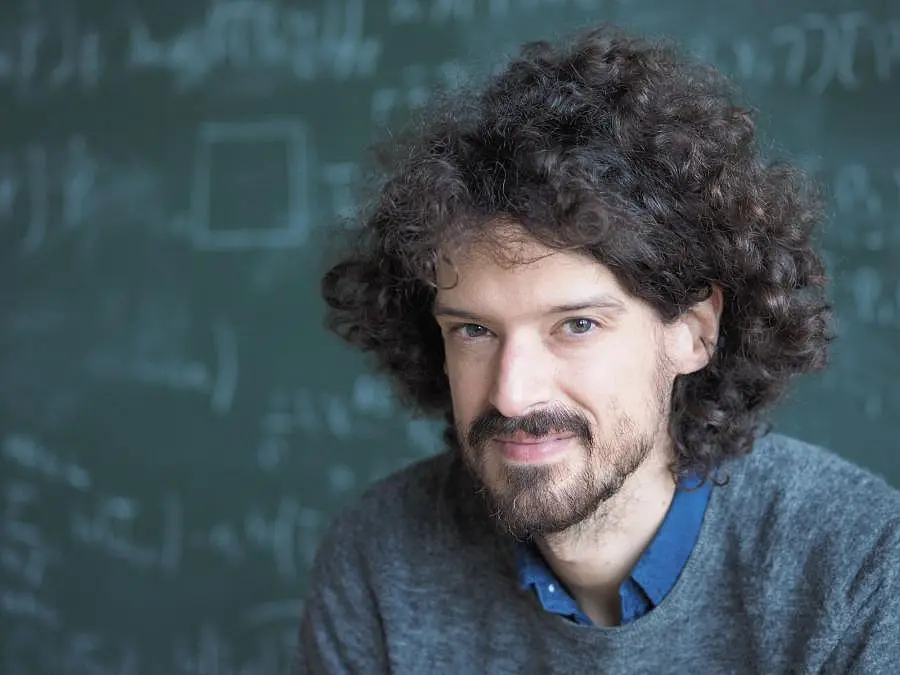
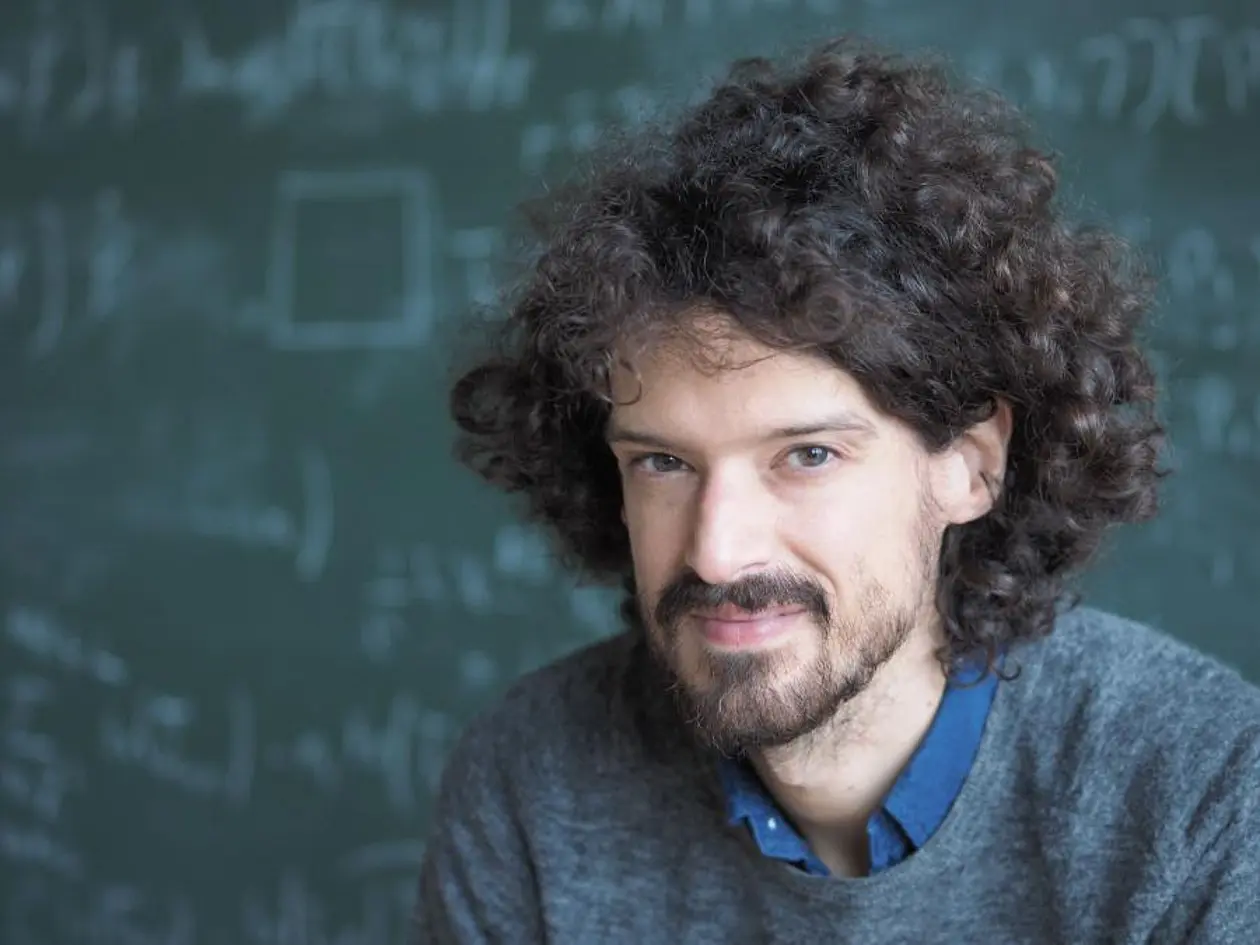
Marcello Porta’s MaMBoQ project – Macroscopic Behavior of Many-Body Quantum Systems – is divided in two parts: The first part focuses on the transport properties of interacting lattice models, while the second part concerns the derivation of effective evolution equations for many-body quantum systems. The common theme is the concept of emergent effective theory: simplified models capturing the macroscopic behavior of complex systems. Different systems might share the same effective theory, a phenomenon called universality. A central goal of mathematical physics is to validate these approximations, and to understand the emergence of universality from first principles.
Porta aims at developing new mathematical methods for the rigorous analysis of complex quantum systems. The first part of the project focuses on the transport properties of two-dimensional quantum systems, such as graphene and topological insulators. These ultrathin materials have attracted enormous interested in physics in the last decade. One of the main goals of the project is to understand the quantization of charge and spin transport for realistic models, taking into account disorder effects and many-body interactions among the electrons. The second part is devoted to the derivation of effective evolution equations for interacting fermions, in suitable scaling regimes. The projects aims at proving the mathematical validity of celebrated effective theories such as Hartree-Fock and BCS theory for mean-field fermionic systems, and the quantum Boltzmann equation for weakly interacting Fermi gases.
Marcello Porta studied Physics at La Sapienza University in Rome, where he completed his doctorate in 2011. He did postdoctoral work at the ETH Zürich, the University of Bonn and the University of Zürich, where he became an assistant professor of Mathematics in 2016. Since October 2017 Porta has been a professor at the University of Tübingen’s Department of Mathematics.