Magazine
29.09.2026
The Learning Empire
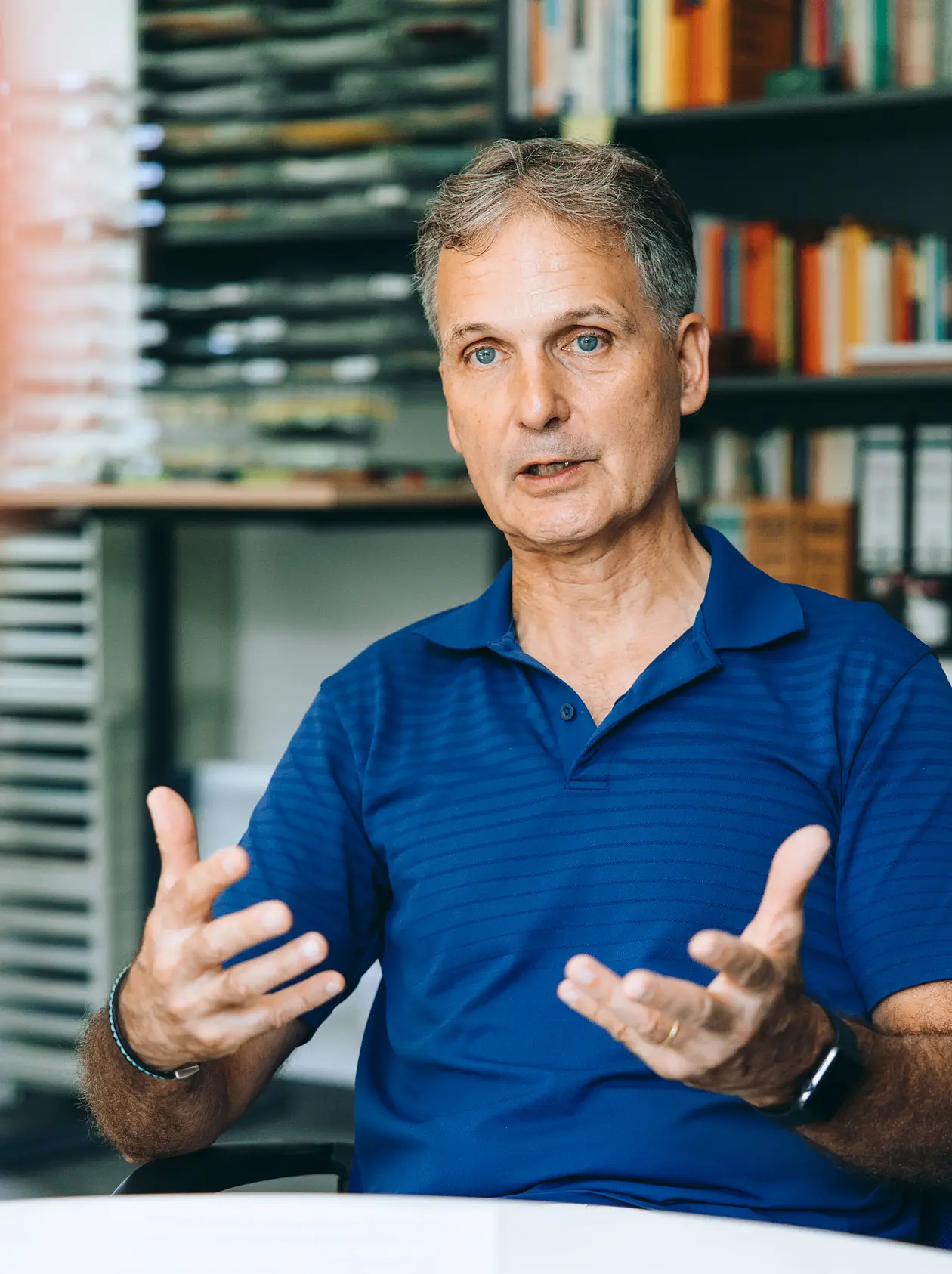
Gunter Schubert is investigating how China is changing our economy and the world order.
Iran is demanding transit fees for the safe passage of ships through the Strait of Hormuz – to be paid in the Chinese currency renminbi. Not in dollars. Does this reveal a shift in the global balance of power?
This requirement represents a move by Iran towards China. Iran has long been one of the states that has deliberately withdrawn from the ‘West’ and regards itself as part of a new ‘Global South’ led by China.
You call China a ‘learning empire’. What do you mean by that?
China today influences every global field of politics and organization, and shares in decisions about who controls the international finance systems, the digital world, global supply chains and outer space. It is negotiating bilateral contracts with many states and regularly convenes them at large forums in Beijing, for example its partner countries in Africa. This is how an empire acts: It displaces existing international structures and binds its ‘client states’ by granting ‘membership benefits’ and promising security and development.
Not a relationship of equals.
That’s a question of perspective. The ‘West’ sees in China above all the emerging power that wants to bring the world to heel. In the Global South it’s often seen differently. Many countries in Africa, for example, from Angola to Ethiopia and Kenya, have over the decades obtained urgently needed infrastructure through loan-financed contracts with China: roads, ports, railway lines, hospitals, schools, administrative buildings, sports facilities – in many ways a requirement for economic development. Capital investment on this scale did not come from the West.
China today influences every global field of politics.
But countries had to get into debt with China for this.
Sometimes massively. But they took these decisions themselves. These projects don’t always run smoothly, but over the years China has learned: it’s repeatedly restructured borrowing and often remitted debts; problems with the sustainability of infrastructure product have been actively managed together with the governments of its partners – for instance, maintenance of the railway connection between Addis Ababa and Djibouti or in the building of the Karuma hydropower station in Uganda. As a result, China has a good reputation in many countries of the Global South, and often a better one than many western countries. They don’t feel it is neocolonial exploitation such as China is regularly accused of.
In Germany we made jokes about the first Chinese cars that failed their safety tests twenty years ago, because they regularly crumpled up in crash tests. Have we underestimated China?
The German car industry has been telling itself this for a long time. For decades it looked at China with justified self-satisfaction. They did great business there and were confident that they could retain their technological advantage for ever. As a result, they were left behind when the leap came in battery technology and electromobility. Catching up is extremely difficult: In high tech advantages usually get larger, not smaller, with time. And this is the problem facing the German automobile industry, which for some time now has been trying to produce for the Chinese market in partnership with these Chinese companies.
There’s been an enormous transfer of know-how from Taiwan to China.

In your new research project you focus on the relationship between Taiwan and the People’s Republic of China, specifically on AI and computer chip technology. Who’s leading, who’s behind?
In the 1990s and 2000s, Taiwanese capital made a major financial contribution to China’s economic rise to being a leading export nation. Companies from Taiwan produced on the Chinese mainland for the world market. This led to an enormous transfer of know-how from Taiwan to China. Over the course of the 2000s, China then went on to gradually develop its own products and technologies. Today, it’s establishing an innovation economy and global market leadership in various high tech sectors. The country still lags behind in the high-performance computer chips that are extremely important in complex AI applications, autonomous mobility and modern sensor-controlled weapons systems. But in almost every other area, China leads the global markets. Taiwan meanwhile is the center of an AI ecosystem in east Asia that is dominated by US corporate customers and wants to detach from ‘red supply chains.’ This is generating geoeconomic tensions which have so far not been studied much in empirical terms.
In the tariffs dispute between China and the USA, talk is consistently of the Taiwanese global market leader TSMC, which has produced over 70 percent of the worldwide market share in semiconductors. Does the global chip industry depend on just one company from Taiwan?
TSMC has a key role in the production of high-performance chips. There are however many other leading Taiwanese companies that play a crucial role in the complex supply chain for the semiconductor industry. All of them are now spreading their investments across the entire East Asia region, the USA and gradually also Europe. It’s exciting for me to study how Taiwanese high-tech companies navigate the current dispute between the USA and China: On the one hand, the major US tech concerns are the principal customers of the Taiwanese semiconductor industry. On the other, the massive Chinese market that the Taiwanese companies also supply beckons, and there, the rule is: once you leave, you’ll never get back in. At the moment, the People’s Republic is still trying to attract qualified engineers and critical know-how from Taiwan. But they seem to be less and less successful in doing so.

For the Chinese market, the rule is: Once you leave, you’ll never get back in.

Can these developments be measured?
Our research project is currently building a database and developing an ‘exposure index’, which will measure the dependency of Taiwanese high-tech companies on the Chinese market. Among other things, we want to examine whether or to what extent the decline in Taiwanese corporate investments on the Chinese mainland actually points to a gradual decoupling of supply chains in the chip and AI driven industry.
If it doesn’t succeed economically, the People’s Republic could blackmail Taiwan militarily or even take it over.
I’m frequently asked: When will the Chinese attack? I don’t like to speculate. But we can ask: Would the United States allow the People’s Republic to take control of the center of the global semiconductor industry? Probably not. For sound economic interests of their own, the United States would probably want to prevent an invasion scenario – quite apart from other geostrategic interests such as stabilizing Taiwan as an important element in what is known as the ‘first island chain’ around the Chinese coast.
Many Taiwanese see themselves as Chinese. At the end of the Chinese civil war in 1949, the Nationalists were defeated by the Communists and fled the mainland for the island of Taiwan. Since then, the People’s Republic of China has claimed the island as its own. What do the Taiwanese think of this claim?
Thirty years ago, a quarter of the population of Taiwan still saw itself as exclusively ‘Chinese.’ Today, that share is just over two percent. At the same time, over 60 percent see themselves as ‘Taiwanese.’ So there is to this extent a solidified Taiwanese identity. The relationship to China is nevertheless very complex. But no one in Taiwan wants to be governed by the Communist Party of China. That’s the national consensus. Surveys also show that people’s willingness to defend the de facto independence of Taiwan, if necessary by arms, is growing. Under Xi Jinping, the current Communist party leader and Chinese head of state, these tendencies have led to China being increasingly aggressive towards Taiwan, and this has become manifest in continuous military maneuvers around the island and in clear cyberwarfare.
Why is Taiwan so important to Xi?
Xi Jinping, who’s been at the helm since 2012, is intensively pursuing his vision of China as a great and powerful nation as well as an internationally respected and permanently stable land under the leadership of the Communist Party. As a result, military capacity is systematically being expanded and economic reforms pushed ahead. Taiwan has been built up by Xi to the crux of all China’s national interests on which the legitimacy of his rule depends. He wants to go down in history as a great leader who brought about national unity.
How should the West respond to China’s display of power?
There’s no alternative to dialogue. The People’s Republic will decisively shape world events in the following decades. Europe has to decide whether it wants to enter into a systemic antagonism with China or instead tries to fight tenaciously and fiercely for every centimeter of political ground with this country. We have to get away from black and white narratives about China and develop a China policy that is based on our own strengths and on a willingness to negotiate guided by principles. We have a long way to go.
Text: Tilman Wörtz
Professor Gunter Schubert holds the Chair of Greater China Studies in Sinology at the Institute of Asian and Oriental Studies of the University of Tübingen. Together with seven other German sinologists, he studies the strategies and methods used by the People’s Republic of China to increase its economic and political autonomy and make other states and regions depend on it, for example, through trade agreements with African states to secure important raw materials such as lithium, with its own space program, and by influencing UNO resolutions, as well as its own chip production and AI industry.
Alongside Gunter Schubert, the project involves researchers from the Universities of Bremen, Bonn, Frankfurt and the Constructor University Bremen, the Helmut Schmidt University/Universität der Bundeswehr Hamburg, the Max Planck Institute for the History of Science, and the German Institute for International and Security Affairs (SWP). It is funded by the German Research Foundation (DFG) as part of the Research Unit 5913.