Magazine
29.09.2026
The town, the genius and the war
For centuries the University of Tübingen flourished in a ‘town’ that today we would regard as a village. Nevertheless – or perhaps because of this – the renown of polymaths such as Wilhelm Schickard spread. He cultivated his numerous talents and defied both war and plague.
The evil omens could only be seen in the heavens for a short time: three comets, the first at the start of August, the other two in November of 1618. These omina in the sky terrified people across Europe, many texts discussed their significance and prophesied doom. As a result, calamitous significance was attributed to the first clashes in far-off Bohemia which developed into the Thirty Years’ War.
A young vicar and passionate mathematician in Nürtingen, Wilhelm Schickard, also attempted to understand the phenomena, working on behalf of the Duke, who “graciously ordered me to record my further opinion of such comets clearly in writing.” Eight weeks later, he presented the text Cometen Beschreibung (A Description of Comets). No astrological interpretation of political events, just a strictly scientific examination. Perhaps he even owed his reputation at the University of Tübingen to the book. Nevertheless, a disaster was brewing: one that eventually claimed the lives of himself and his entire family.
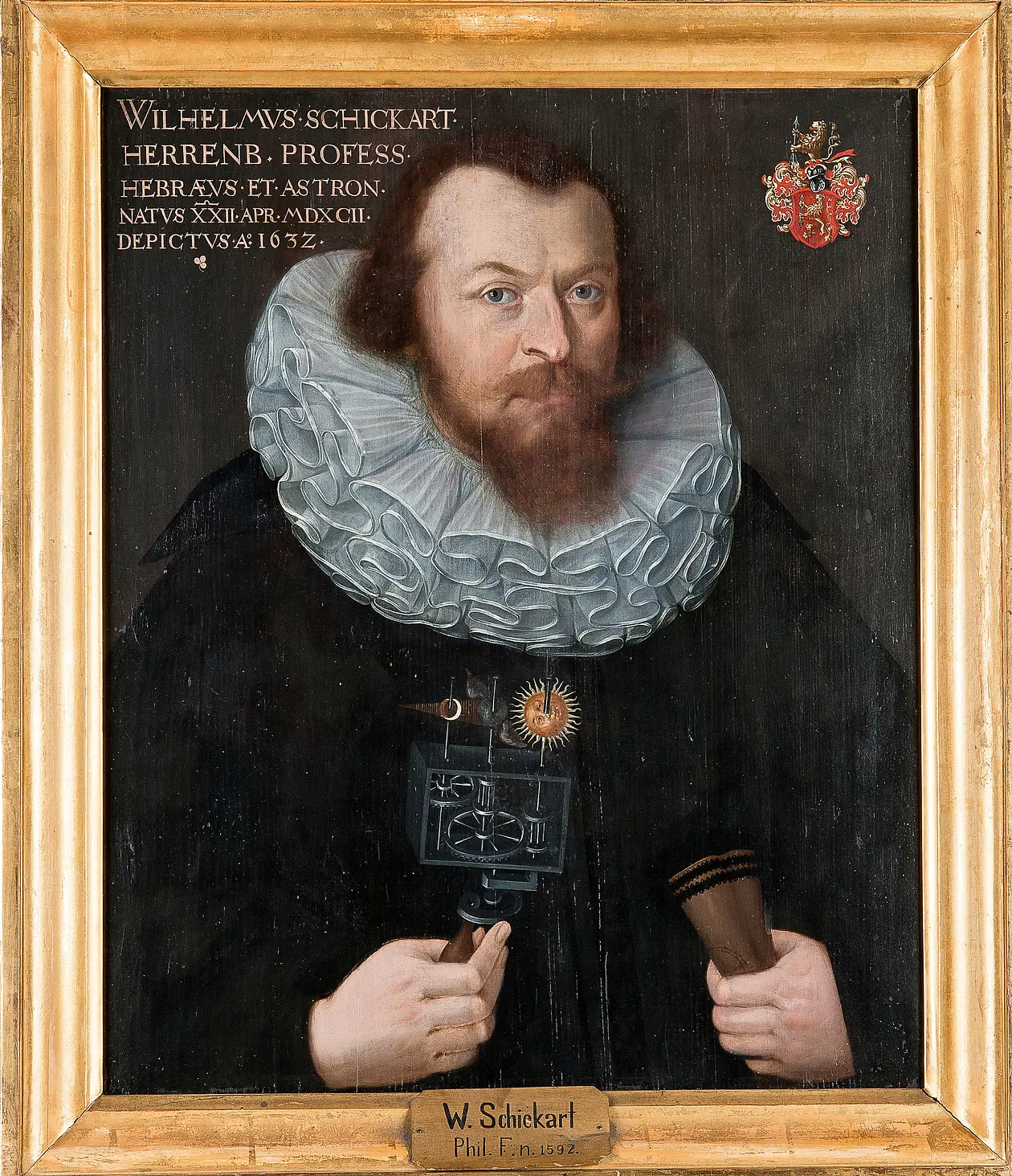
Schickard pursued his fascination for science until shortly before his death. He was proficient in eight languages, or perhaps even ten – depending on how this was counted. He could read the Koran in Arabic, was a Professor of Hebrew, Astronomy and Mathematics, and as well as inventing the mechanical calculating machine on the side, he engraved elaborate etchings, taught military architecture, measured Württemberg, published a bestseller and corresponded with hundreds of other scholars. He was a polymath, a master of many disciplines such as were practiced in the centuries between the Middle Ages and the industrial revolution, even in a small university town such as Tübingen1 – or perhaps specifically here.
He could read the Quran in Arabic and was a professor of Hebrew.
Wilhelm Schickard was born in 1592, the son of a Herrenberg carpenter. Aged 14, he began attending the convent school in Bebenhausen that was run by his uncle. This opened the way to a theological career, free of charge. He studied Theology in Tübinger and passed all his subjects with the top grade, A.
His first appointment took him to nearby Nürtingen as the deacon. At the same time he learned Aramaic, the native language of Jesus Christ. He wrote an Aramaic grammar for his own use, as well as a text on optics, and produced numerous etchings. The imperial astronomer and mathematician Johannes Kepler learned of Schickard’s virtuosity and ordered first of all woodcuts for his textbook Epitome Astronomiae Copernicanae, the first on the heliocentric world view, and later copper plates for his famous work Harmonice mundi, in which Kepler mathematically describes the orbital period of a planet and its distance from the sun. The two developed a lifelong friendship. The Duke of Württemberg also became aware of Schickard, and supported his appointment in 1619 to the Chair of Hebrew at the University of Tübingen.
Anyone who wanted to enter the town, which lay between the Neckar and Ammer rivers, had to pass through one of the five town gates in the double walls, each with a barbican and an inner gate tower. Every evening the gates were shut at the signal of a trumpet or bell.
The citizens dumped their own urine and feces along with the manure from their cows and pigs in the gutters. Narrow, crooked streets and stinking tanneries and butchers’ shops along the little Ammer river characterized the lower town; while stately houses of several storeys dominated in the upper town around the market place and Collegiate Church. Bakers and butchers offered their wares on the ground floor of the town hall. The tanners were on the first floor and were not permitted to sell anywhere else. On the second floor the law court held session and the town council met. In front of the town hall there was a pillory where those convicted were put on public display. The Collegiate Church was the heart of both spiritual and academic life: both examinations and graduation ceremonies took place there.
When Schickard moved to Tübingen, three to four thousand people were living there.
When Schickard moved to Tübingen, it had three to four thousand inhabitants, half of them farmers and vintners, butchers, bakers, cobblers and tailors. On top of this came 500 members of the University: students, professors and their servants, as well as pharmacists, booksellers, printers and binders.
It was usual for scholars to be paid in both money and in kind, and Schickard was no exception. He received rye, spelt, oats and wine from the University's fields and vineyards; even peas and lentils when they were available. Schickard was permitted to keep two cows and to graze them on the common. He received a basic salary – as Professor of Hebrew at the Faculty of Humanities far less than he later received when appointed Professor of Astronomy. In addition there were supplements for participating in public debates, and a share of fees for doctorates. For an academic funeral oration, Schickard received two golden guilders. Professors’ pay was exempt from taxation, as was the supply of wine – and they made good use of this, including to entertain the students that they were obliged to house in accordance with their contract with the university. Moreover, professors were exempted from bonded labor or having to give quarters to soldiers – that was left to the common people.
The university was already shaping the town, yet around 1600 Tübingen was primarily a trading and commercial town. Well-to-do Tübingen families lived from the long-distance trade in cloth, grain and wine. We no longer know the precise location of Schickard’s house, but every morning, at six in the summer, at seven in winter, he walked through the alleyways to the Old Aula, the lecture hall, or to the Burse, the student residences, where lectures were also given. He often worked late into the night on his studies and observed the celestial bodies.
One of Schickard’s studies stands out above the others in its influence: the Hebrew textbook Horologium Hebraeum, first published in 1623, 98 pages long, repeatedly revised and republished up until 1731, including in Leipzig, Amsterdam, Utrecht, London and Copenhagen. It was the most successful Hebrew textbook of its day. In it, Schickard formulated the theory that Hebrew was the original language which God himself had taught to Adam and Eve in Paradise, and from which all others derived. He saw a crucial sign of this in the Hebrew word ‘śaq’, which had remained unchanged in every language known to him, including in the German ‘Sack’. This reveals Schickard’s ability to simplify complex connections.
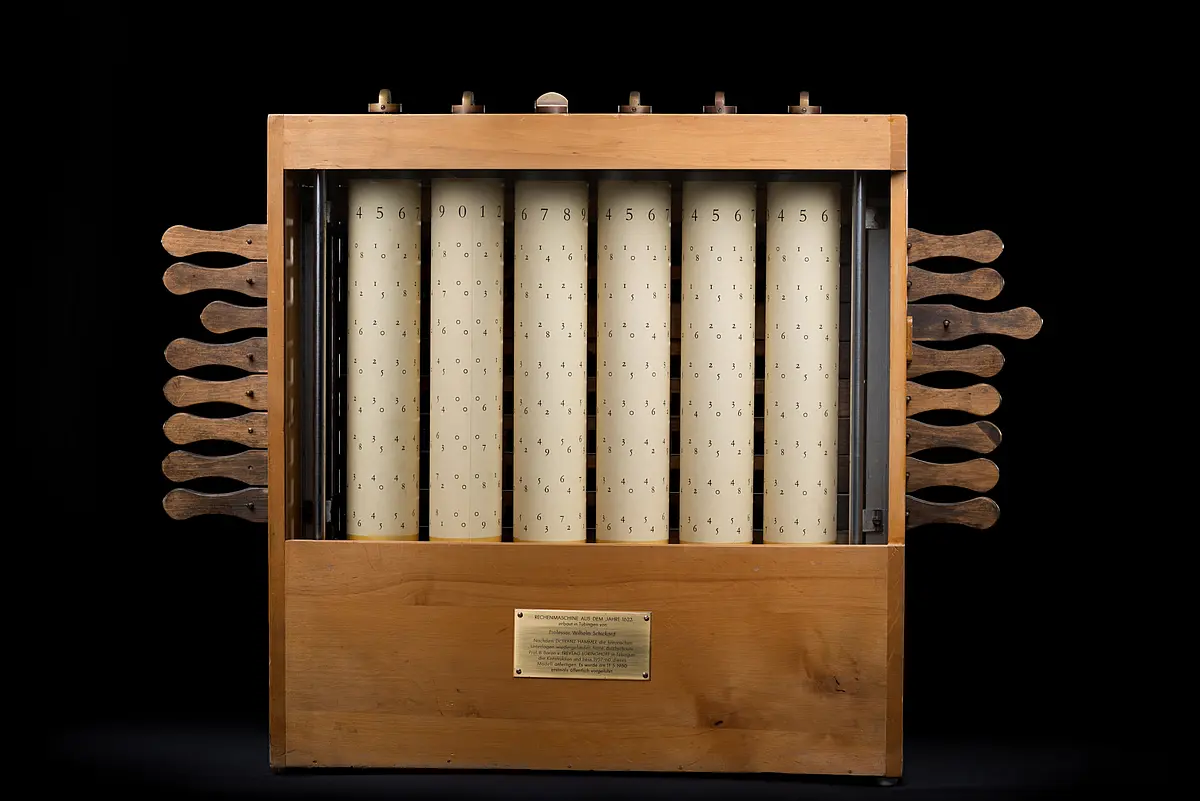
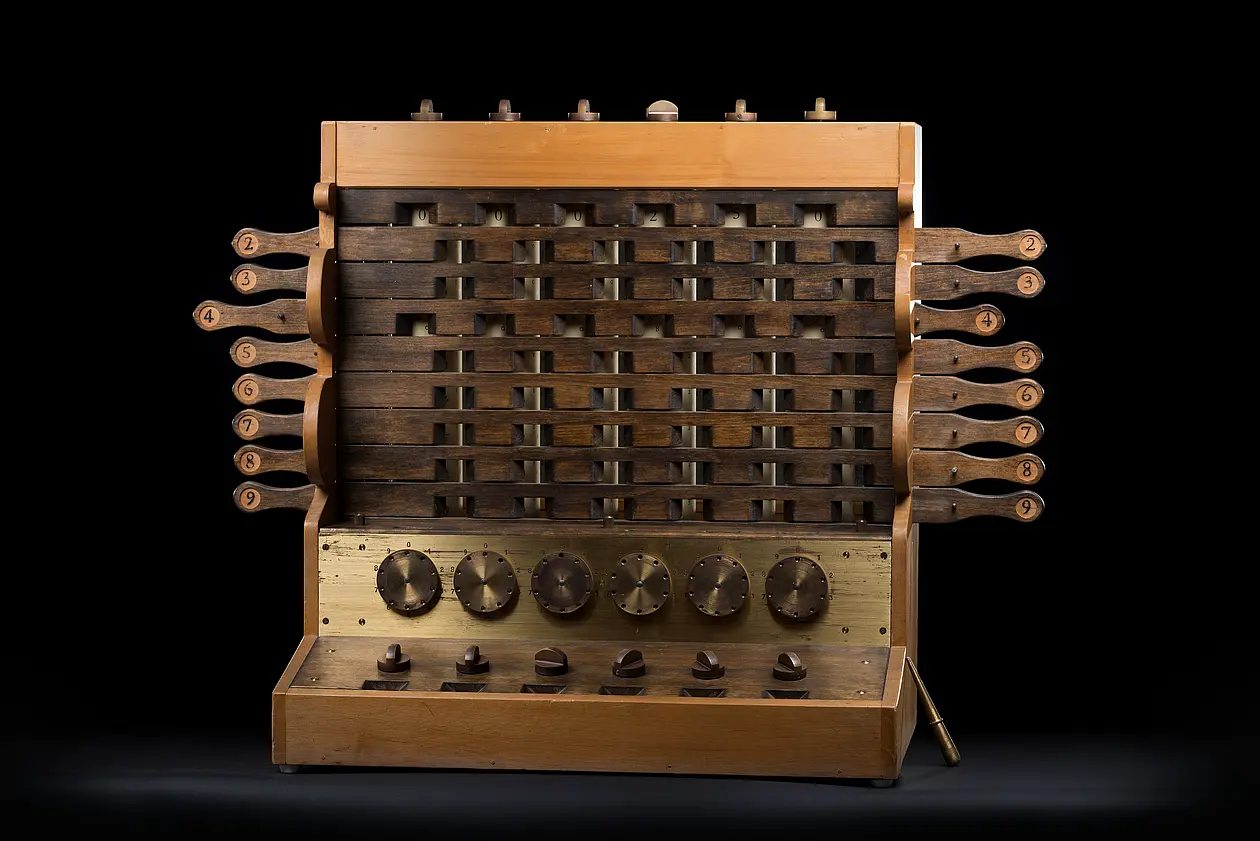
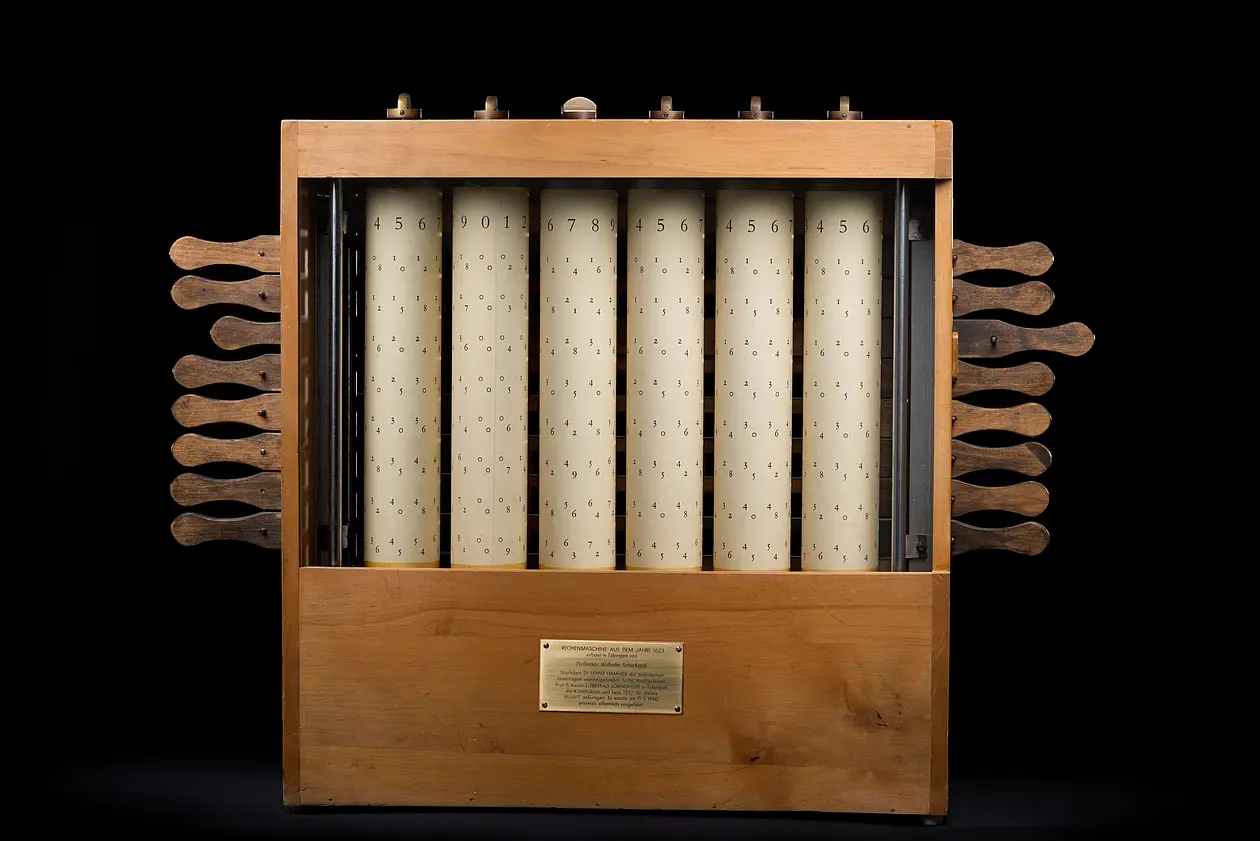
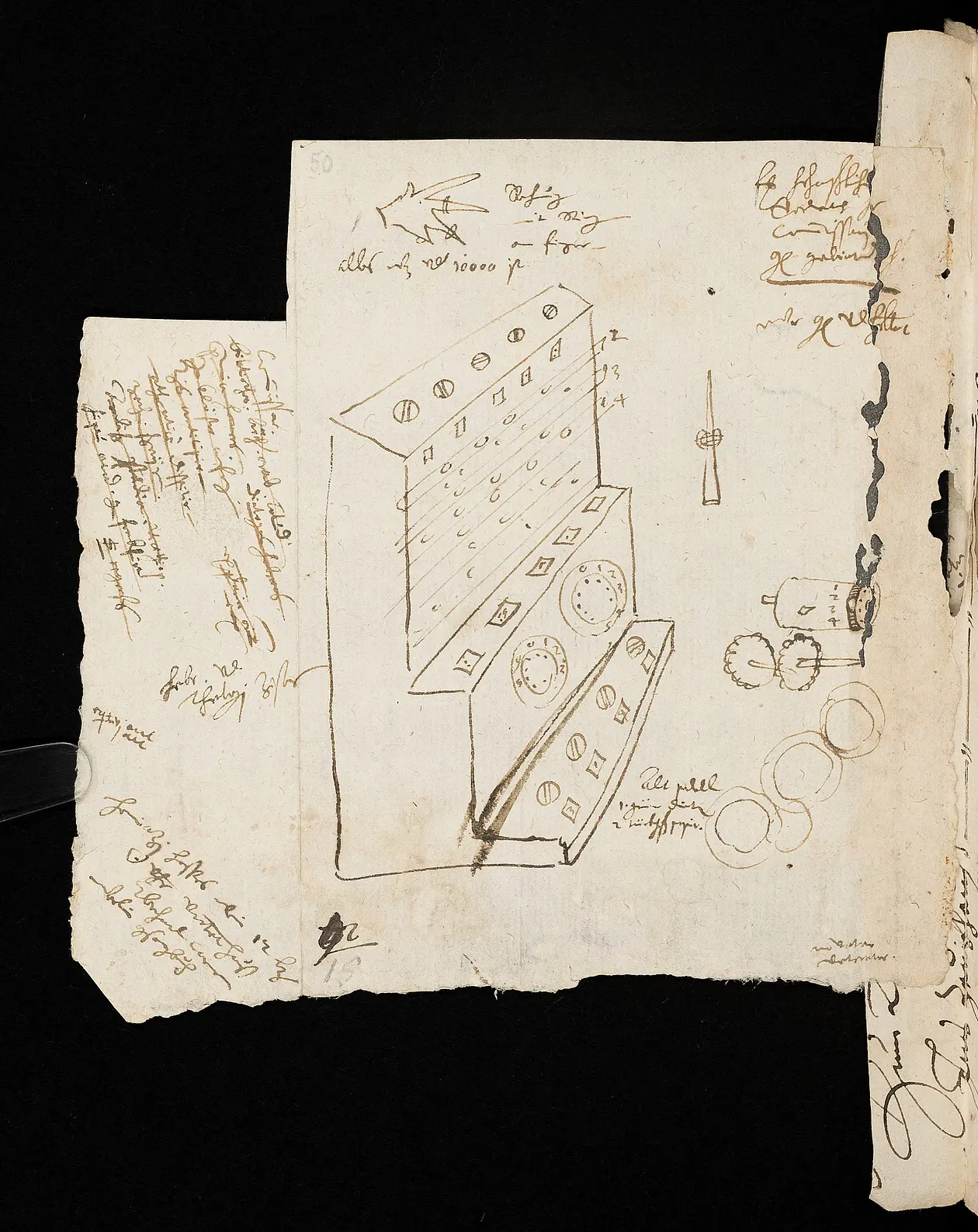
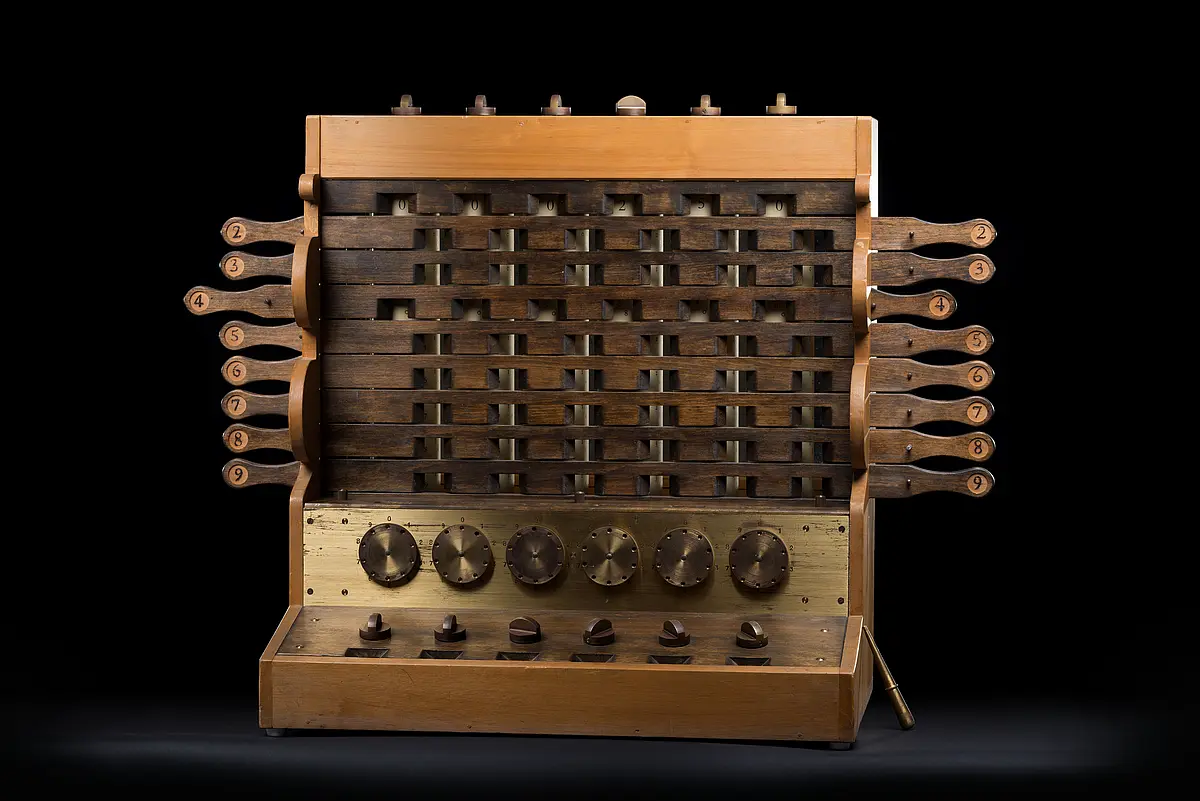
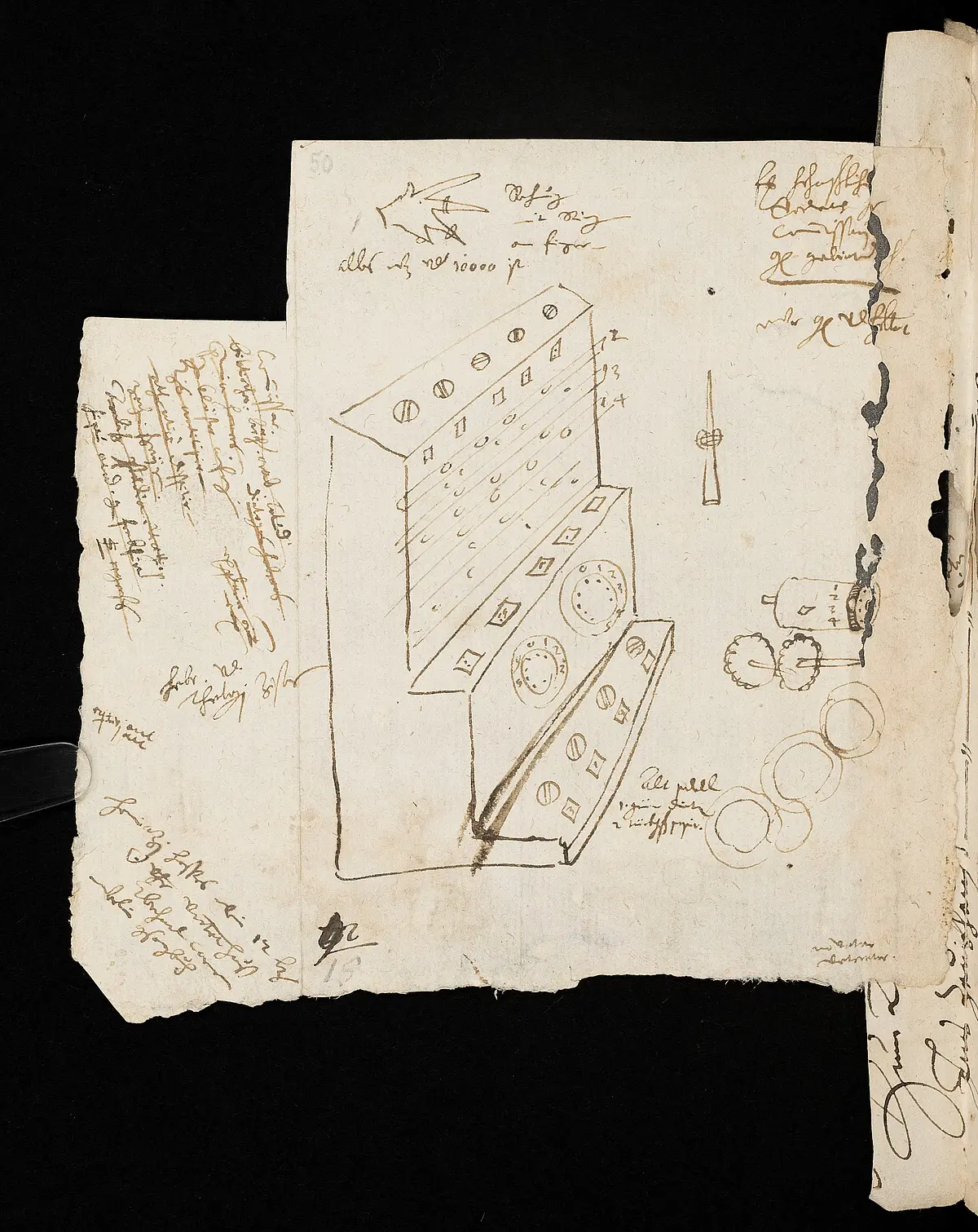
There was also his talent for mechanization, which led to his most important invention: the mechanical calculator. This machine, which was invented in the middle of the Thirty Years’ War and destroyed in a fire in his workshop, only became known through a letter to the astronomer and physicist Johannes Kepler dated September 20, 1623: “Moreover I recently attempted what you did mathematically by mechanical means, and constructed a machine of eleven complete and six modified cogs from existing machines.” With fine lines, Schickard sketched the design of his invention.
The construction could operate with a maximum of six-digit figures in all basic forms of calculation: addition, subtraction, multiplication and division. Most importantly, it succeeded in automatically carrying the ten, when a small bell supposedly struck as the last digit jumped from 9 to 0. Schickard could now calculate the movements of celestial bodies more quickly and easily than by conventional methods.
He observed the celestial bodies intensively, and invented a hand-held planetarium which clearly displayed the orbits of the sun, moon and planets. In 1631 he was finally appointed to the Chair of Astronomy, Mathematics and Geodesics, after his predecessor Michael Mästlin died.
Moreover I recently attempted what you did mathematically by mechanical means.
Schickard to Kepler
As school inspector, he also visited Latin schools throughout Württemberg, to improve his salary, and while traveling the countryside by horse he measured it and drew far more precise maps than had previously existed.
Much though the university and Tübingen shaped and defined his life, the town limits were still far too narrow for his scholarly spirit. Wilhelm Schickard had few friends at the university, instead corresponding with scholars throughout Europe, almost exclusively in Latin, mostly on scientific questions, very rarely about matters that we today would describe as ‘personal’.3 A comprehensive edition of his correspondence contains 353 letters to Schickard and 98 different writers. His most extensive correspondence was with the Strasbourg professor of history, Matthias Bernegger, with whom he developed a deep friendship even though they never met in person.
Meanwhile, the war came ever closer – and with it the plague.
On July 1, 1631, Tübingen was besieged by 24,000 soldiers. Schickard took his wife and four surviving children to safety in the county of Hohenberg and buried his scientific manuscripts. Yet, at the last minute, an agreement was reached that prevented the capture and plunder of the town: The troops withdrew once the town had paid many ‘contributions.’
However, after that Protestant Sweden suffered defeat at the hands of the imperial armies near Nördlingen in 1634. Württemberg’s Duke had already fled and soldiers ravaged the land, plundering and murdering as they went, laying waste to nearby Calw and approaching Tübingen. Then Schickard, Professor of Mathematics and Orientalism, noted in his faculty book: “Abandoned to our fate, by all – the councils and nobility of the land had also fled – we gathered trembling in the middle of the night in the Senate and threw ourselves on the mercy of the victors to save the lives of innocent children.”4
Abandoned to our fate by all we gathered in the middle of the night in the Senate.
It was hardest for Schickard’s mother. Soldiers attacked and maltreated her. Schickard wrote to his brother Lucas: “Our devout mother finally died of the wounds that wicked soldiers inflicted on the guiltless old woman. She had withstood immeasurable agonies for twelve days long. O this pitiful death, for which no tears can be enough. Believe me, some days I found this blow of fate so hard to bear that the rector of our university, who even feared for my life, could hardly restore me to a calmer demeanor.”
And with the troops, the plague also came to Tübingen. On October 20, Schickard’s daughter Ursula Margaretha died aged 16. With her, he lost not only his eldest child, but also a trusted helpmate: Schickard had taught her in Latin, Hebrew and Mathematics. She knew how to use the instruments to study the stars, and helped him with his astronomic measurements. Soon after, his wife and daughters Judith and Sabina also fell victim to the plague, along with two maids and a student who lived with him. Five sons and a daughter had already died in earlier years. So only his nine-year-old son Theophil remained. “How bitterly I bear this lamentable fate, that makes me incapable of any serious work and only thinking of the art of dying,” he wrote to Bernegger. The cases of plague in his household led to a Senate resolution for house arrest being placed on him. His doctor advised him to flee as the ‘best medicine’. But Schickard, finally sick himself, wanted to remain. “It grieves me for the many efforts, for the many sleepless nights, for the many half-done studies,” he wrote to his friend Bernegger.
Yet he recovered from the plague, and was even able to take part in Senate meetings again. For his lunar observations, he attempted to obtain a Galileian telescope, and fervently wrote letters to French correspondents.
In September 1635 the plague returned to Tübingen. The university had to close, the students left the town. Schickard too fled with Theophil to the village of Dußlingen, which was free of plague. Yet he worried about the furnishings, the wine, a new telescope and his scientific works that were left behind. At the start of October he returned to Tübingen. In his final days, he found the strength to write a preface to Johann Ochsenbach’s translation of a Persian classic, Gulistan by Saadi. But he once again fell ill with the plague. On October 23, 1635, Schickard died aged 43; one day later his son Theophil followed him. His last letter, in which he discussed the observations of Pierre Gassendi on the lunar eclipse, was unfinished
Text: Tilman Wörtz
1Seck, Friedrich: „Wilhelm Schickard – Herkunft und Werdegang“, in: Köpf, Lorenz, Bauer (Hg.): „Die Universität Tübingen zwischen Reformation und Dreißigjährigem Krieg“, Jan Thorbecke Verlag, 2010, S. 353ff.
2Seck, Friedrich: „Wilhelm Schickard – Herkunft und Werdegang“, in: Köpf, Lorenz, Bauer (Hg.): „Die Universität Tübingen zwischen Reformation und Dreißigjährigem Krieg“, Jan Thorbecke Verlag, 2010, S. 11ff.
3Benigna von Krusenstjern: „Gelehrtenexistenz im Dreißigjährigen Krieg. Wilhelm Schickard in seinen Briefen“, in: Alf Lüdtke, Reiner Prass (Hg.): „Gelehrtenleben“, Böhlau Verlag, 2008, S. 33–45.
4Walter Jens, Eine deutsche Universität, 500 Jahre Tübinger Gelehrtenrepublik, Kindler, 1977