Article
19.11.2026
All just an illusion?
How does a Grönemeyer song come to be? As part of the 39th Writers’ Lectureship at the University of Tübingen, the German singer-songwriter Herbert Grönemeyer spoke with author and literary researcher Michael Lentz about music, language, and the contradictions in Grönemeyer’s work.
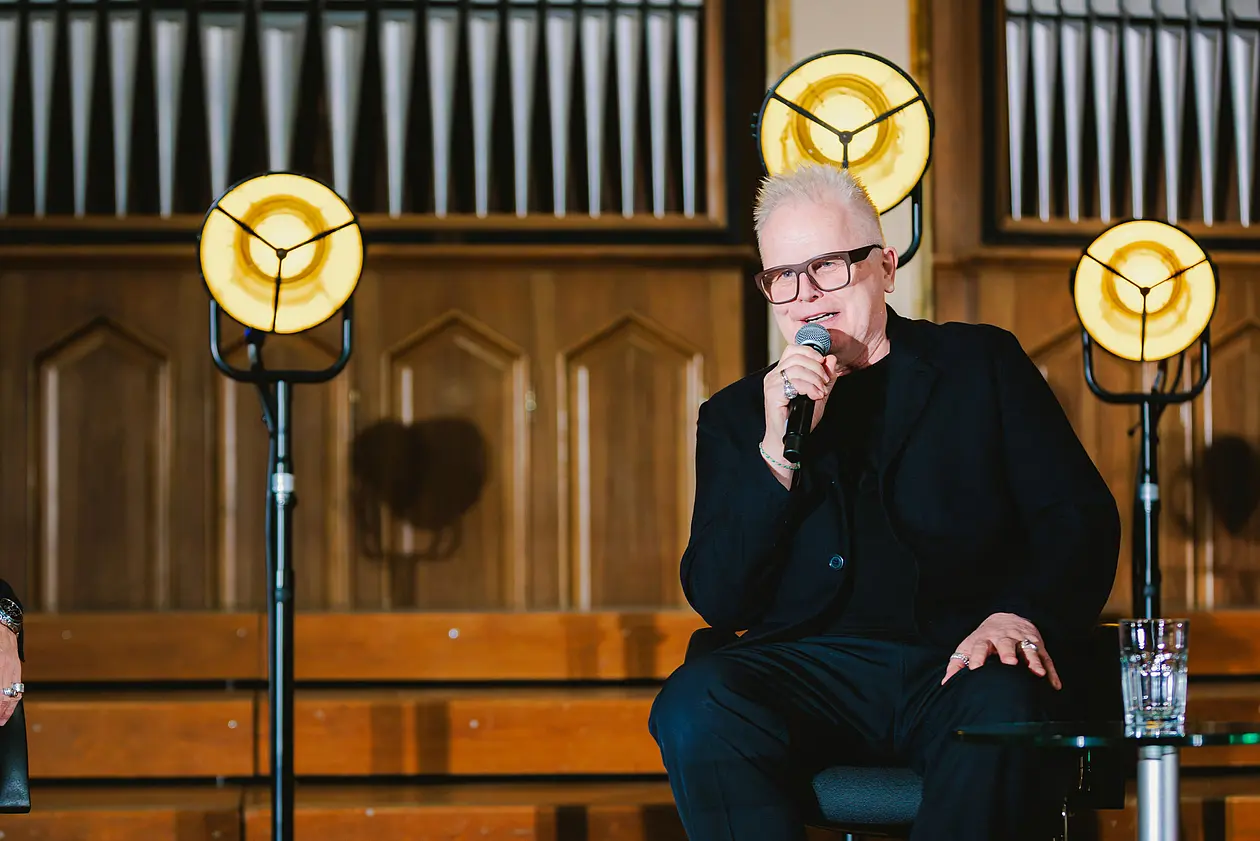
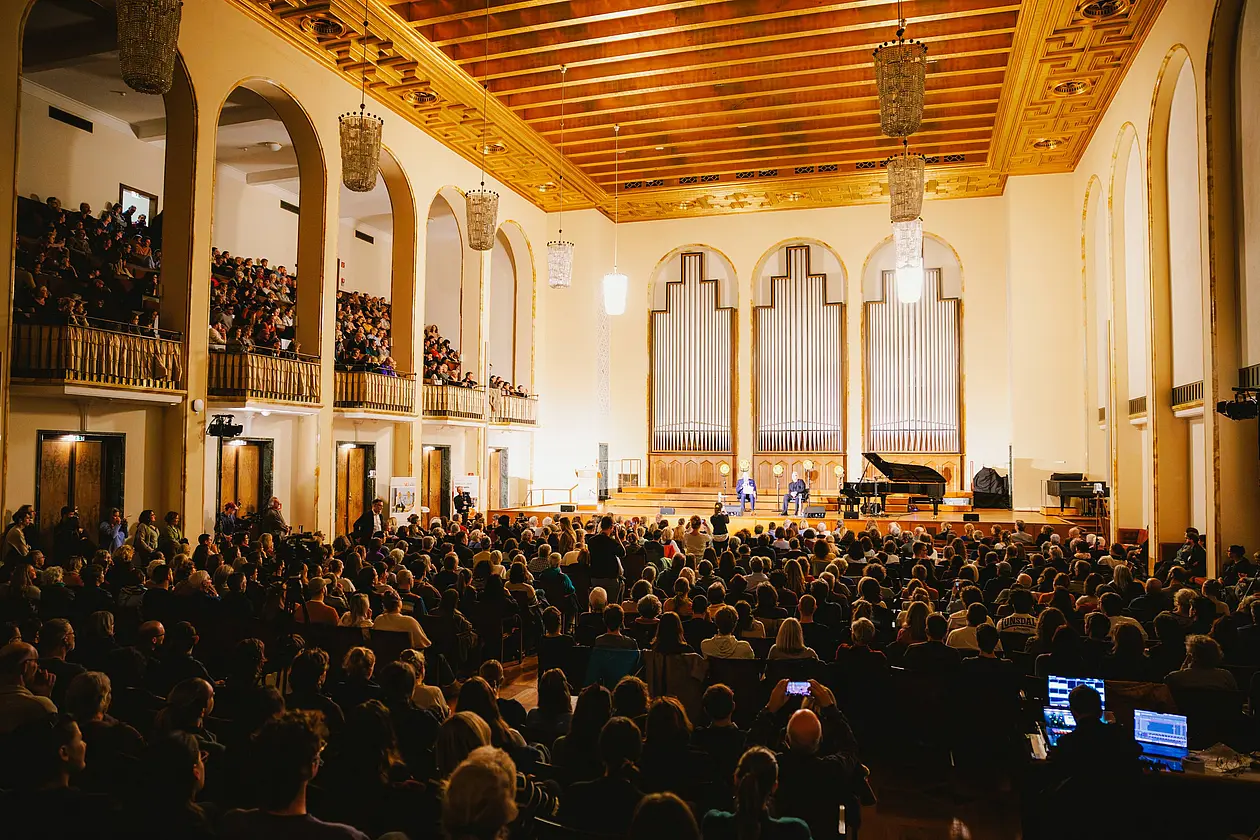
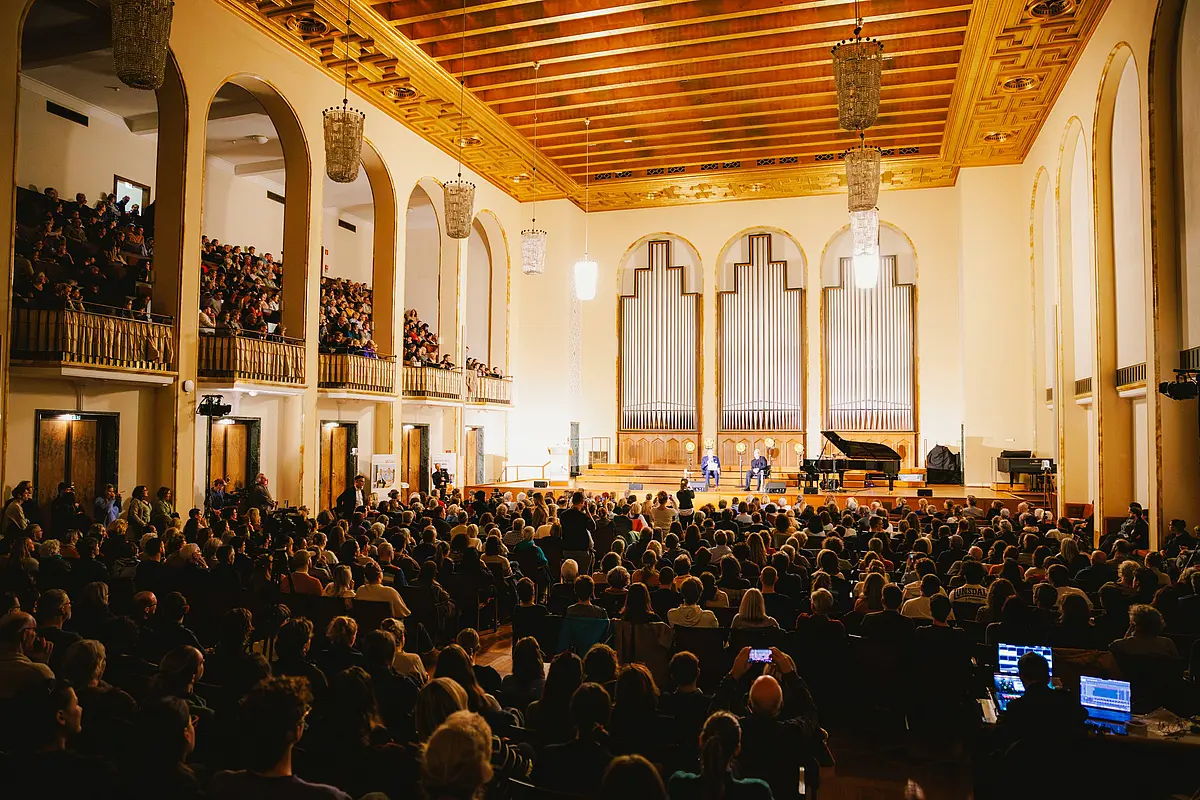
Up on stage in the packed auditorium of the Neue Aula, it wasn’t quite clear who was lecturing and who was listening. Herbert Grönemeyer was listening to his friend, the author, musician, and literary scholar Michael Lentz. Lentz interpreted and analyzed. Lentz and Grönemeyer listened to Grönemeyer, whose singing issued from the loudspeakers or who now and then played the piano. Lentz lectured with academic gravitas – and listened as Grönemeyer ironically subverted this analytical perspective. The famous musician clings to the naivety of his own work, because, he says, “I’ve always been an impostor.”
Together, the two launched the 39th University of Tübingen Writers’ Lectureship. The theme of the evening was simply: Grönemeyer. And because Grönemeyer didn’t open up, Michael Lentz shone an even brighter light on him. Together, the two explored Grönemeyer’s relationship with language – seemingly a mass of contradictions.
“I couldn't sing the way I wanted to”
“I've always loved to sing,” said Grönemeyer, “but the lyrics, they get in the way.” And then, there was his father, who was a die-hard Faust fan and could recite Goethe’s epic almost entirely by heart; he always underlined the importance of lyrics. Then there was a producer who told Grönemeyer he couldn’t understand him when he was singing. There were attempts to tell stories in the words in his songs – and the realization that it just didn’t work.
Reflecting on his early career, Grönemeyer said “I couldn’t sing the way I wanted to.” He had to work to earn that licence and to overcome the limitations of language. Only then did the playful, iconic poetry emerge, the very thing people like about him and which has even become the subject of a book published by Reclam. Was it all just a fluke, no more than an illusion?
In the interview, Lentz tracked the process by which a Grönemeyer song comes to life. It often begins with improvisation on the piano. Musical motifs give rise to melodic contours that gradually coalesce into a melody. This melody is then developed further until a key emerges that suits the mood of the piece. The search for lyrics to accompany the music - that comes last.
From pseudo-language to poetry
Language is still a challenge, said Grönemeyer, one of the writers at this year’s Writers’ Lectureship, “The time spent writing lyrics, those are the worst months of my life.” And so Grönemeyer puts language and meaning aside. He develops melodies and moods using what he calls “banana English.” Lentz calls this “pseudo-English vocalization.” A vocal language that sounds like English – or sometimes French – with elongated vowels, flowing sounds, and, every now and then, phrases and sentences that are actually language. It has no meaning, but it conveys mood and melody.
When Grönemeyer then sat down at the grand piano and performed a yet-to-be-released song in his finest banana English. It sounded a bit like this: “There a whyle tryn a dooooo, awebber believe ebnba fooo, oooooh ah.” Something like language, with rhythm, drawn-out vowels, melody, and emotion. Then the audience, too, realized how meaning can emerge where language departs from common ground. “Isn’t it nice that you don’t have to understand the lyrics?” Grönemeyer asked as he sat back down in his chair. “The beauty of art is that people use it to create spaces where they can engage with themselves. Music does that even without lyrics,” he said.
But the lyrics aren’t as random as they might seem at first. “I have to tailor the lyrics to the melody, it really has to fit,” Grönemeyer said. “There are some songs that I love especially, and with those I know: If I don’t robe them properly with lyrics, the music falls apart.” Lentz agreed, speaking once again less figuratively, more analytically of the semantic correlations that the lyrics give to the chords.
For Grönemeyer, however, it’s not always about the lyrics complying with the music: “The German language is very well suited to creating dissonance,” he said. And he introduces this dissonance wherever he feels the need to counteract anything too kitschy.
“It hardly matters what you sing, you’re singing Grönemeyer”
What did the audience see at the end of nearly two hours? Lentz explaining Grönemeyer’s own art to him. Grönemeyer listened to these interpretations with interest, skepticism, and a touch of sarcasm. Ultimately, he insisted he works in a far less planned manner. “I’m always surprised by the kinds of interpretations that come up,” he said. “I just cook it all up and hope that whatever comes out tastes good.”
For two hours, the audience got to see a friendship between artists, just as Lentz had told them they would. He added that people in a friendship like this learn from one another and put up with the contradictions. In that spirit, Lentz conceded: “It hardly matters what you sing, you’re singing Grönemeyer.”
And that’s exactly what he did, one last time. After some hesitation, the artist reluctantly sat down at the piano and sang his song “Immerfort.” The words were mumbled, the vowels drawn out, the stress patterns jarring; yet the feeling still came across. It’s nice that you don’t have to understand the lyrics.