Uni Tübingen

Article

06.11.2026

Launch of SI Days: Discussions on the value of knowledge
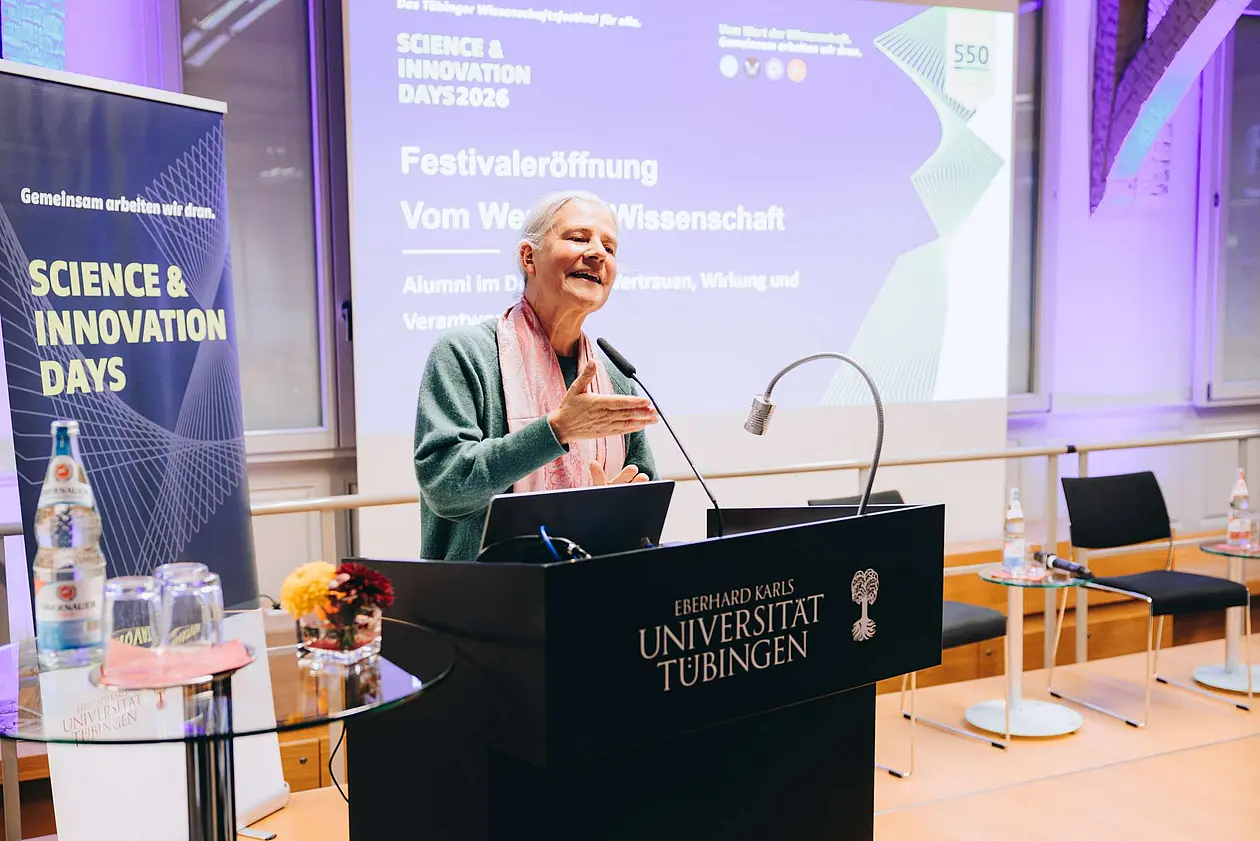
University of Tübingen president, Professor Karla Pollmann, launched the Science & Innovation Days on Thursday.

The University’s annual Science & Innovation Days (SI-Days) kicked off on Thursday, November 5. The University of Tübingen’s public science festival brings together researchers, citizens, and stakeholders from politics, business, and civil society in interactive formats to engage in dialogue. In 2026, the SI Days were part of the University’s anniversary celebrations under the motto “the Value of Knowledge.”

“This is a festival for everyone! It’s for both the city and the surrounding region, because there should be scientifically grounded knowledge wherever people live and work,” University President Karla Pollmann told some 100 visitors at the festival’s opening in the Alte Aula.
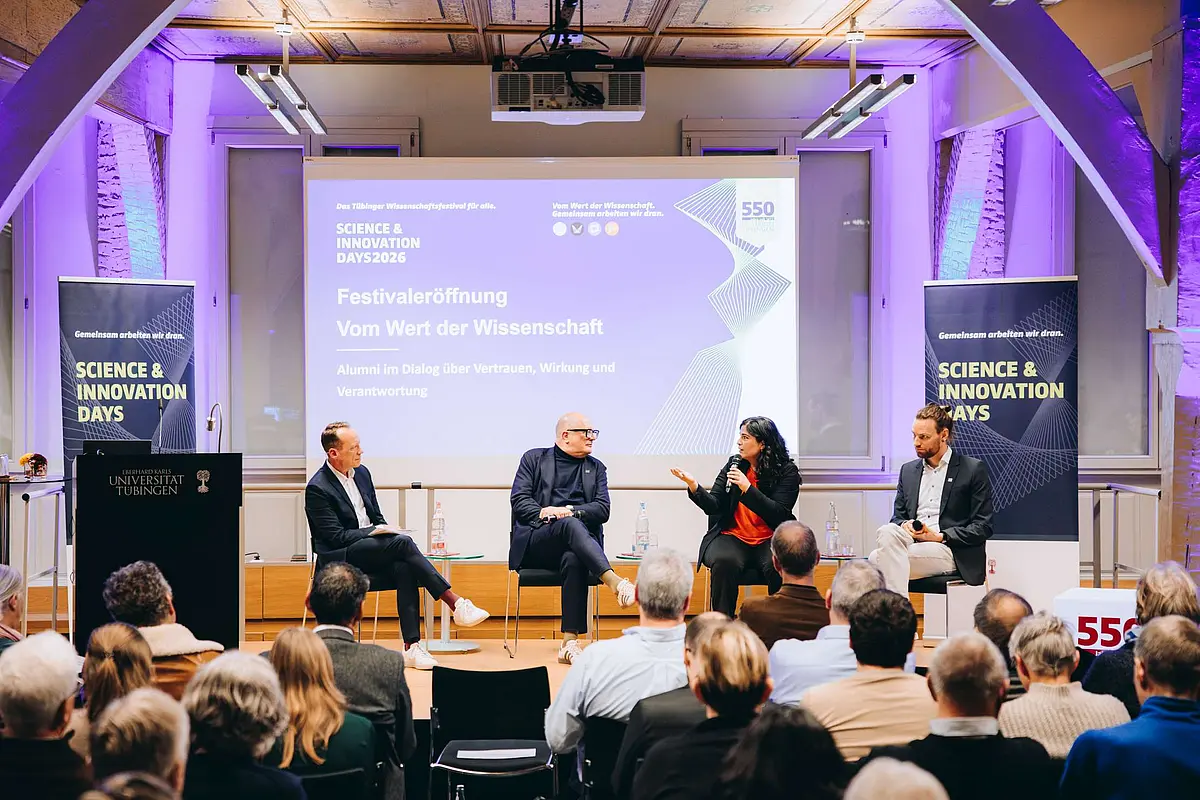
Panel discussion with alumni

Marcel Wagner, head of regional radio SWR’s Tübingen studio, chaired a discussion with three former Tübingen students. Moritz Bross studied biology and earned his Ph.D. in the field; he now works as a researcher at BASF. He said one of the values of academic knowledge is scientific thinking, which he learned while working on his Ph.D. and which also helps him in everyday life. “I find it very enriching,” he said.

Ghazaleh Tabatabai is a neuroscientist who earned her Ph.D. with work in Tübingen and other places; she now conducts research into brain tumors at the Tübingen University Hospitals. For her, scientific knowledge is achieved through enduring setbacks and solving contradictions. “It is the driving force that always takes us one step further and yields new insights,” she said.

“Democracy needs science-based facts”

Andreas Sentker studied biology and rhetoric in Tübingen and whose career has included editing the “Knowledge” section of the weekly newspaper DIE ZEIT. For him as a journalist, the pursuit of academic knowledge is “the best system we have for explaining the world.” The despots of this world fear a system that questions, argues rationally, and seeks answers, he said. “Democracy needs science-based facts.”

This opening-up of research to the public was raised by Ghazaleh Tabatabai during the discussion. “We have to face up to the need to take our social responsibility more seriously: explaining research so that the message gets across,” she said. This is why she, a Medical Director at the University Hospitals, and other researchers, is actively involved in the association “Science for Democracy,” which was founded specifically for this purpose. When asked whether she even has time for this alongside her profession, Ghazaleh Tabatabai pointed to the University’s Excellence Strategy, saying “We see this as part of our work.”

Debate brings in perspectives from outside

As a researcher in the private sector, Moritz Bross has a different perspective on resources. Compared to those in University research, he says, he is well-equipped in many respects. What he appreciates about his work is that his contribution “has a real impact. That’s what bothered me at the University right up until the end.” However, he feels enormous pressure to succeed.

Andreas Sentker said applying research is essential, and pointed to vaccine developer Curevac, saying it helped put German research back on the global map. He noted that China has now surpassed Germany in research, as evidenced by the publications in the prestigious journal Nature.

Focus on communication and problem-solving

Ghazaleh Tabatabai advocated for strengthening problem-solving and communication skills in the curricula. “These skills shape values and personality. We’ll never be able to compete with AI when it comes to facts, but we certainly can when it comes to critical engagement,” she said. For Andreas Sentker, too, “rule-based skepticism” has become more important as a cultural tool in the age of AI. “We need the comprehensive university; that’s where our strength lies,” he added.

The panel agreed that AI is a tool and that young people growing up with it do not automatically lose their curiosity. “People haven’t become any less curious since we’ve had Wikipedia,” said Moritz Bross. It is this curiosity, Sentker said, that often defines the value of knowledge, a value that is often not immediately apparent. 

President: “University is a community that transcends time”

President Karla Pollmann referenced Wilhelm Schickard, who invented a calculating machine - the first computer - in the 17th century. At the time, amid the Thirty Years War, no one took any notice. “A University is a community that transcends time. It’s like being in a bank account that continues to exist as time flows on, yet we don’t know when the dividends will come.”

Stefan Bentele