Magazine
02.10.2026
The Future of Studies
AI writes surprisingly well. What changes does this mean for teaching and learning?

The Brechtbau is a temple of intellect: Experts in German and English linguistics and media studies flock to its offices over six floors, miles of library shelves house books. In their breaks, students hunt for a space to sit on the ‘lawn’ – a green-carpeted open area on the first floor with benches and alcoves – where they can focus on their notes from the last lecture.
Mika Sperr, student of rhetoric, sixth semester, is also sitting there. She obviously put stickers on her laptop once, but tore them half off. It’s not possible to study without a laptop these days. But what about without AI?
“I really want to produce writing on my own,” Mika says, slowly and thoughtfully. Of course she uses AI herself, especially when she’s under pressure – for research, to edit texts, and sometimes even to help formulate a thought. “But just for support. If I allowed AI to interpret a text for me, I wouldn’t learn much.”
Mika – like 500 other students and researchers from the University of Tübingen – completed a questionnaire from Professor Christoph Bareither and Dr Lukas Griessl and then took part in an in-depth interview. Bareither and Griessl are cultural researchers specializing in digital lifeworlds, and work closely with AI researchers. For their study1 they investigated the question: How is AI changing social sciences and humanities? What is it doing to teaching? What does this mean for our understanding of ourselves?
I strive to write on my own.
Rhetoric student Mika Sperr

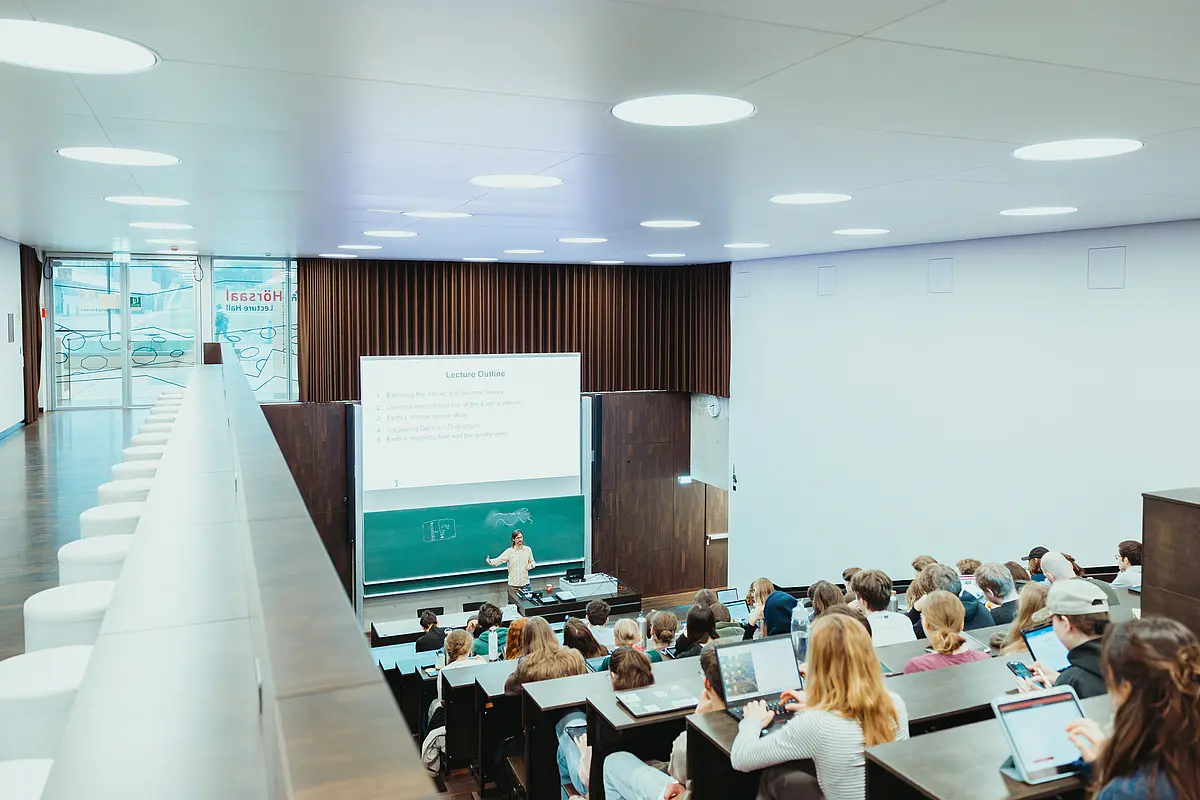
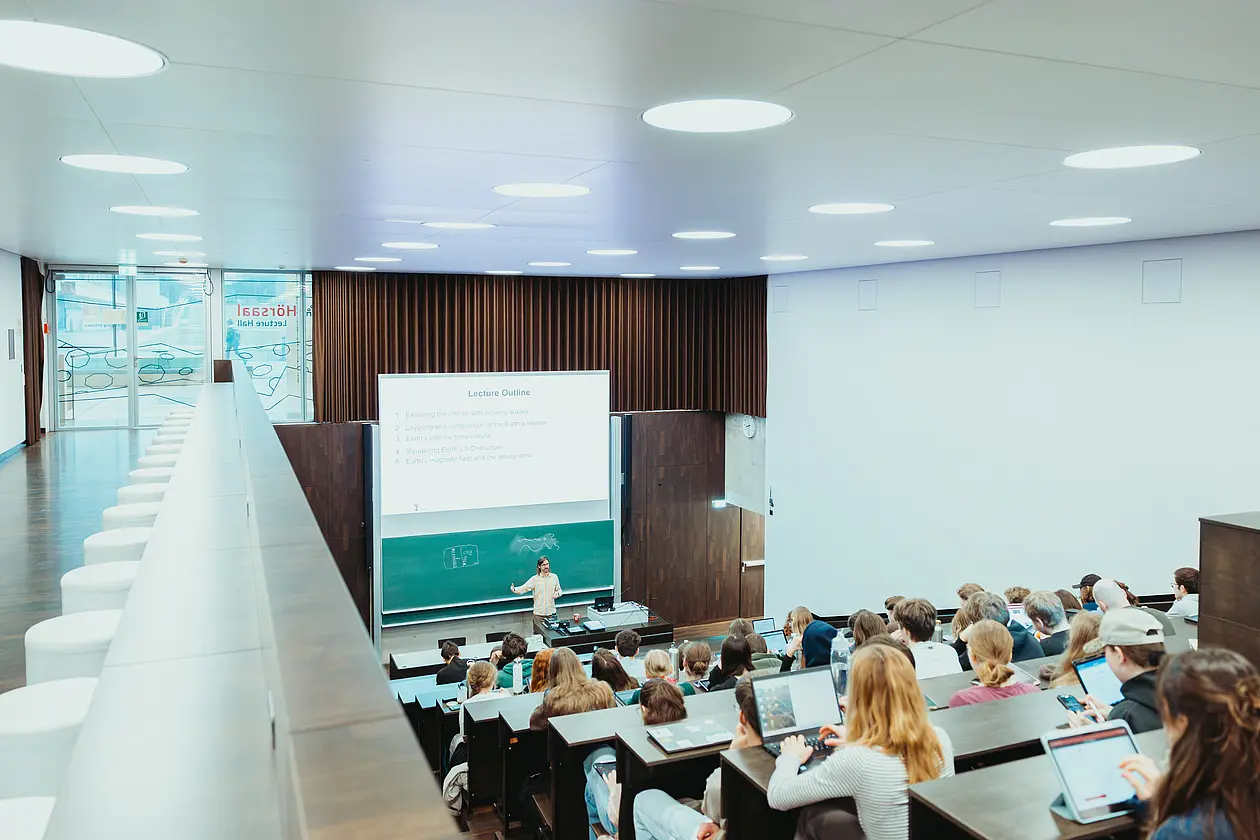
They presented their results in a Studium Generale lecture at the end of the summer semester. “Who believes we had this lecture written by AI?” Bareither asks the 64-strong audience. All but three put their hands up – no one wants to be seen as naive – they’ve seen astonishingly good quality AI writing experiments too often. “The answer will surprise you,” says Bareither, “but we’ll come to that later.”
He stands at the lectern in front and reads answers from pseudonymized respondents to the study: “Toni, a philosophy student, thinks: ‘80 percent of homework is synthetic now’ – in other words, made using AI.
Petra, a sinologist, states: ‘ChatGPT makes me question why I bother being a student of Chinese studies.’
Adam is inclined to agree: ‘Why study at all?’
Susanne, a teacher, wonders: ‘Why should I read and assess homework that was created by AI? It makes no sense.’”
The quotations are all similar. As a good cultural scientist, Bareither doesn’t judge them. He simply states that many speak of a ‘sense that their role is being devalued.’ Texts are the currency of the humanities, yet LLMs such as ChatGPT are astonishingly effective at ‘scraping’ them: Producing reading lists, suggesting text structures, writing homework, summarizing study results, outlining lectures.
Who thinks I had an AI write my lecture?
Griessl stands at a second lectern to the right of the professor and describes a nightmare vision. Plainly put: “We’re moving towards a hollowed-out world. With AI, every student has their own ‘personal professor.’ But it only conveys information and doesn’t understand them. Scientific progress will become devoid of people. We’re losing our reference points: Who is in charge? Who checks information? The humanities are becoming superfluous.”
It’s quiet in the room. Everyone is struck by this nightmare vision. Then Bareither relieves the anxiety with a contrasting Utopia: “Used intelligently, AI can take on routine tasks, provide teachers with more time for the students once more, and be a tool for students.”
What kind of world will we live in?
Bareither and Griessl can’t answer this, of course. But they can say whether AI actually wrote the lecture. “The answer is: Yes and no,” says Griessl. The two wrote the lecture both with AI and without, in order to compare the results. “The contents of both were good,” says Bareither. But in the end they used the lecture that they themselves had written, because the key question was: “What would this lecture be worth if we hadn’t written it ourselves?”
And this is where the logic of social sciences and humanities differs from that of natural sciences and medicine. There, the faster you have results, the faster new treatments can be developed, the better. However, in social sciences and humanities it turns out. Sometimes it is precisely the fact that an academic work was produced by a human being that gives it its value.
The value of handwritten examinations
By contrast, Philipp Hennig conducts research into AI from a scientific perspective. He develops his own AI systems, heads the Tübingen AI Center, and was until recently the dean of studies responsible for organizing teaching at the Tübingen Cluster of Excellence Machine Learning: New Perspectives for Science.
Hennig sits in the back row of an empty lecture hall. In a few minutes he will be giving his introductory lecture on the theory of computer science and discussing with his students whether there can be such a thing as chance. He knows the capacity of AI and is following its rapid development. His conclusion: “On my courses all exercises and written examinations have to be submitted in handwriting on paper. I’ve moved away completely from the previous digitalization.”
For his lectures he does sometimes have mathematical problems visualized by AI, and then discusses the results with students. But the important factor in this is transparency: “After all, why should they listen to me if I don’t speak authentically based on my own knowledge?” Naturally, the students actively engage with computers and AI at the AI Center. Of course they do, says Hennig. In computer science and machine learning especially, entirely new skills will be essential in future – above all, communication and the knowledge of how knowledge can be transferred to industry and society. Hennig puts it like this: “The value of a development always arises through interaction with the physical, social world.”
And then he concludes with a sentence that is remarkably similar to Bareither’s Utopian concept: “AI holds up a mirror to us and challenges us to think about who we are and what makes us human.”
Text: Franziska Hammer
1 Christoph Bareither, Lukas Griessl: Hybrid epistemic practices and the transformation of academic assemblages: generative AI and epistemic messiness in the qualitative social sciences and humanities“, AI & Society, 2026, https://doi.org/10.1007/s00146-026-02988-w