

News
07.05.2025
Stopping Microbial Invaders
Scientists Discover Predictable Patterns in Bacterial Invasions
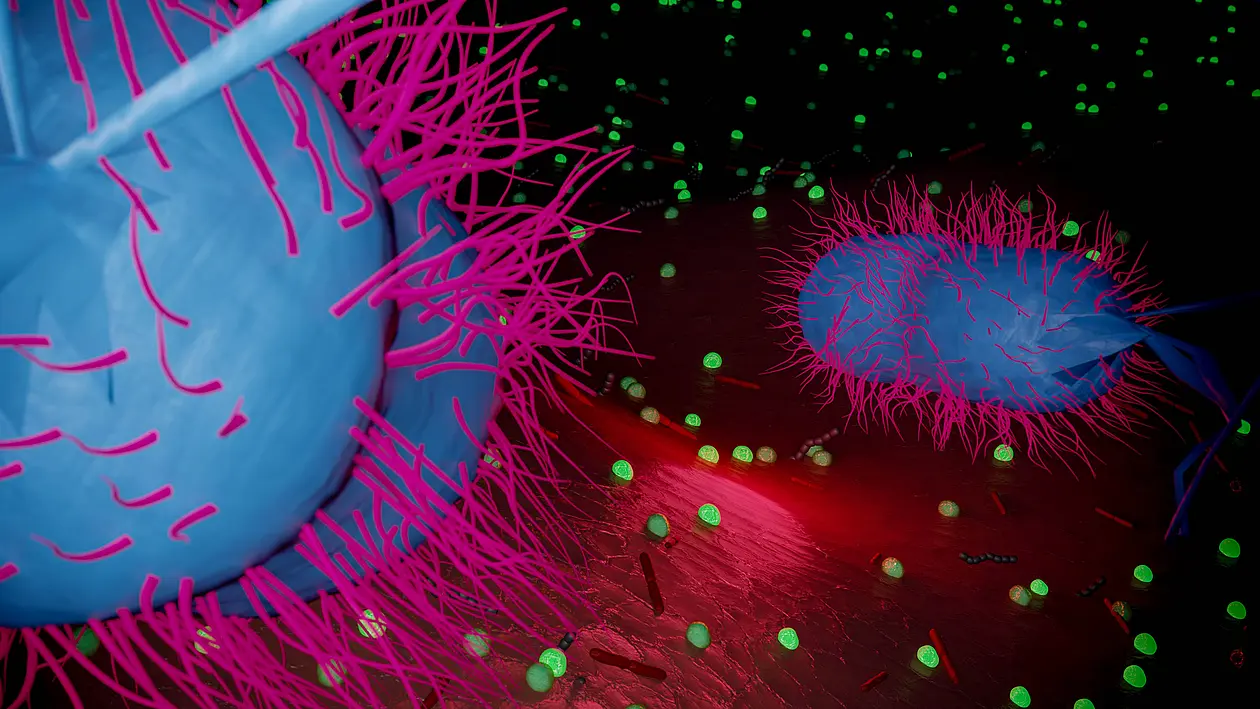
Researchers from the Cluster of Excellence “Controlling Microbes to Fight Infections” (CMFI) at the University of Tübingen have uncovered a new way to understand how bacteria invade—and sometimes fail to invade—new environments. Their findings, now published as in Nature Communications, shed light on how native microbial communities can block invaders, offering hope for better ways to prevent infections and design protective microbiomes.
Microbes are expert travelers, hitching rides on air, water, and even other organisms to reach new habitats. But when they arrive, they don’t always find empty space. Often, these territories are already teeming with local microbes that fight back. This natural defense mechanism is known as “biotic resistance.” Understanding when and how this resistance can block an invader is crucial, especially when it comes to harmful pathogens that threaten human health, agriculture, and ecosystems.
The team studied microbial invasions in lab-controlled environments and identified three distinct outcomes: invaders can spread smoothly, advance in sudden bursts, or be completely stopped in their tracks. These behaviors depend on two key factors: how the invader interacts with the local microbes, and how fast the invader spreads.
Surprisingly, the researchers showed that they could predict these invasion patterns using a simple mathematical tool—one that doesn’t require knowing every detail about the microbial species involved. This "parameter-free" framework could be used to estimate how resistant a microbial community is to invaders, making it a valuable tool for medicine and biotechnology.
“Biotic resistance isn’t just an ecological curiosity,” says lead author and research group leader at CMFI Christoph Ratzke. “It has real-world implications, from preventing disease to designing probiotics that can successfully integrate into the gut microbiome.”
The study opens new avenues in microbiome engineering—helping scientists design communities that can block harmful microbes or make it easier for beneficial ones to settle in. Whether it’s stopping a dangerous gut infection, protecting plants, or improving soil health, understanding microbial invasions could soon become a key part of our future viability.
CMFI Cluster of Excellence
Share


