Uni-Tübingen

What the witch trials reveal about economics

Economic historian Jörg Baten studies violence, education, and growth using unconventional methods for investigating historical contexts.

Economists usually work with prices, costs, and profit. Your research refers to body heights or ages in witchcraft trials. Why is this?

We want to perform research on historical contexts sometimes dating back centuries or even millennia that cannot be analyzed with conventional economic models due to a lack of data. Using the historical data that is available to us, we can answer questions for the first time such as investigating the influence the equality of women had on economic growth in a region over the past 500 years. 1

What have you discovered?

We can show clearly that there was a positive influence from women having a relatively good position. Women taught children – both boys and girls – at a time when there were no schools, and thus contributed significantly to the formation of "human capital," as we economists say. The more work experience women were able to gain themselves, the more they could pass on to their children. The growth rates of different regions also varied because of this educational effect.

How do you measure women's education? They probably didn't have school certificates.

No, it’s not that simple. In the 17th or 18th century, only a few people learned to read, write, and do arithmetic. Most people were illiterate. There were no school certificates. Nevertheless, “numeracy skills” differed significantly from region to region. By this, economic historians mean whether people can represent something with numbers and have a sense of proportions and simple probabilities. We can estimate female numeracy skills, for example, by looking at the ages they reported during witchcraft trials. During interrogations, the accused were asked for their age, and the inquisitors documented their answers. If a woman said she was 60 years old, it either meant she was actually 60 or that she was roughly estimating her age. By looking at many answers from a region, we can see whether women often rounded their ages to the nearest ten or five showing low numeracy skills – or whether they could give precise ages. Regions where women were better with numbers were also regions that developed more economically over the centuries. We were able to demonstrate this connection statistically.

What use is this method to us today?

At our department, for example, we work with the United Nations on their Global Education Monitoring report, a global overview of education levels – not just for children, but also for adults. Studies on rounding in age statements can help determine which regions should receive development aid first, because the greatest effects are expected there – for example: northern Nigeria or northern Burkina Faso? Knowing the numeracy skills of people in a region can also be helpful for the success of malaria programs: The stronger these skills are, the more effective malaria programs tend to be – because people are better able to follow doctors' recommendations and instructions. We are currently researching this connection with the Institute of Tropical Medicine at the University of Tübingen.

What conclusions do you draw from differences in body height?

Body height reveals a lot about the nutrition and health of people in a region. The better the nutrition, the taller people become. And the greater the deviation from average height, the greater the inequality in a society. We can draw on skeletal remains from thousands of years and thus have enough data to make statements about body height. In the past twenty years, however, this indicator no longer works as well for the richest countries due to consistently good nutrition. But in the centuries and millennia before, we can draw fairly reliable conclusions. Even about the likelihood of a civil war breaking out.

How so?

For example, in the decades before the American Civil War of 1861-65, the differences in body height between unskilled workers and higher income groups – and thus in the overall population – increased from 1.6 to 3.0 centimeters. This increase in differences points to a much more unequal distribution of income.

If inequality in a country increases – as measured by body height – does the likelihood of a civil war in that country also rise?

That is the conclusion of our analysis of the past two hundred years in 150 countries around the world. From this, we developed a forecasting model for the outbreak of civil wars. Today, in addition to body height, we also have actual income data available for countries worldwide.


Trust and contracts are important if the economy is to grow.


Where is inequality currently rising?

For example, in Great Britain, China, India, and Russia. Also in the USA, where inequality has risen sharply over the last decades, increasing the likelihood of a civil war from ten to 21 percent.

So the risk of a civil war in the USA has doubled?

Yes, that's a dramatic increase in the probability of a civil war. But of course, many other variables determine whether a civil war actually breaks out: Has there already been violent conflict in a country? What efforts does society make in search of compromise? How established are democratic processes? However, as inequality increases, the willingness to compromise and acceptance of democracy decrease. That's why this indicator is so interesting.

Why do you, as an economist, deal with violence statistics?

If you step out of this building and someone knocks you down, your wellbeing decreases significantly – completely independent of your income. In addition, your trust in other people declines. You become more suspicious. Maybe you enter into contracts much more hesitantly. But trust and contracts are important if the economy is to function. Economic historians think a lot about what a high or somewhat lower level of violence does to economic growth.

How do you apply this method?

For example, we studied the impact that the emergence of cities in Mesopotamia had on violence and thus the wellbeing of these societies. To do this, we examined thousands of skulls with violent trauma evidence, severed bones, or skeletons with arrowheads embedded in them.3  American psychologist Steven Pinker argues that violence has continuously decreased over the millennia.4  Our analyses paint a more nuanced picture. For example, with the founding of the first city in Uruk and similar cities in Mesopotamia, there was a very strong increase in violence. For this statistical analysis of skeletal finds, the statistical methods of economics are very helpful. 

How do you convince students to take an interest in economic history?

I tell them that they will learn statistical methods and apply them thoroughly and that these skills are needed in many international organizations, for example.
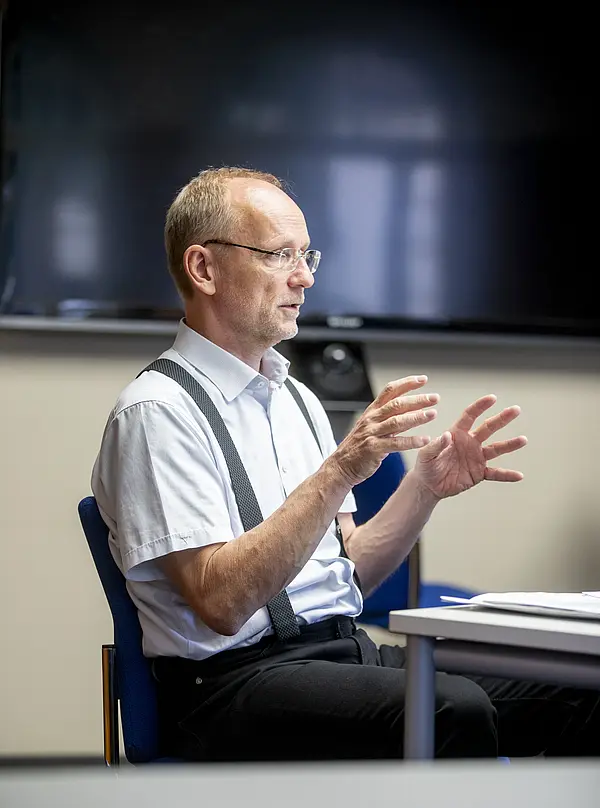
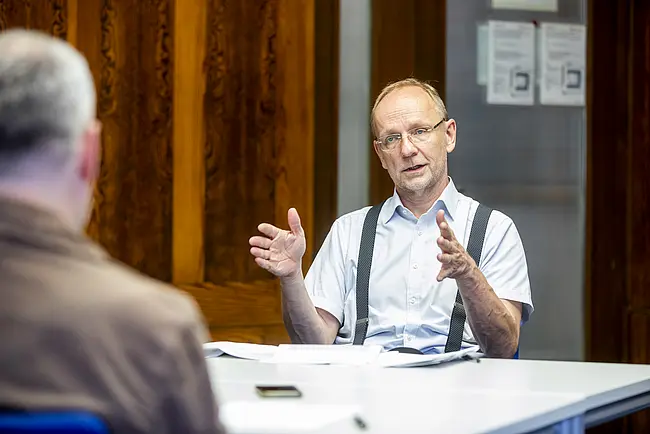
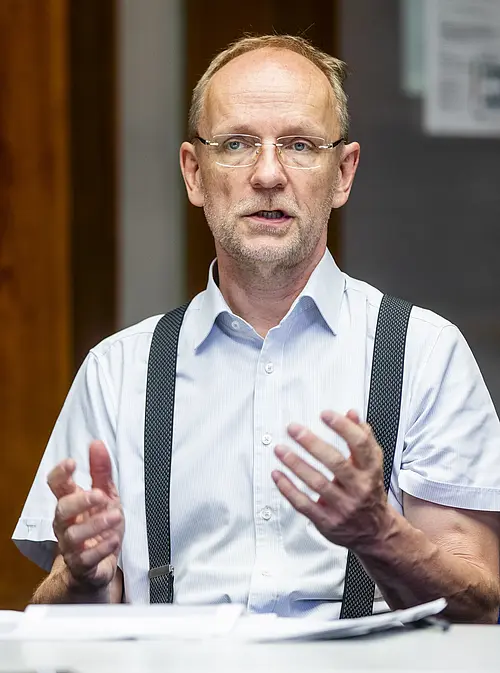
Economic historians are giving a lot of thought to how high and low levels of violence affect economic growth.


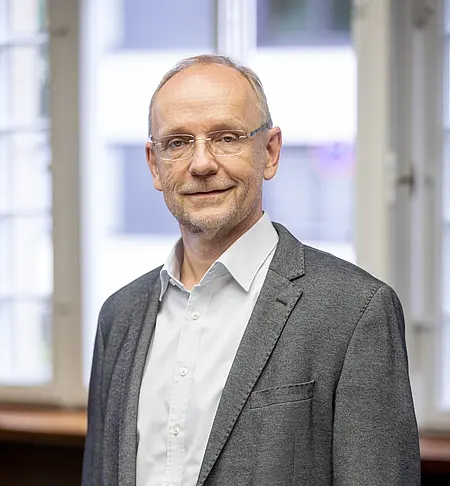
Professor Jörg Baten began his studies in economic history and computer science in Freiburg and then switched to economics in Munich. 

Since 2001, he has held the Chair of Economic History at the University of Tübingen. For many years, he was Secretary General of the International Economic History Association.


1 Joerg Baten, Alexandra M. de Pleijt, „Female autonomy generated successful long-term human capital development: Evidence from 16th to 19th century Europa, World Development, October 2022. https://doi.org/10.1016/j.worlddev.2022.105999 

2 Laura Radatz, Jörg Baten: „Measuring Multidimensional Inequality and Its Impact on Civil War Out-break in 193 Countries, 1810-2010”, Review of Income and Wealth, 2025, https://doi.org/10.1111/roiw.70016 

3 Jörg Baten et al.: "Violence Trends in the Ancient Middle East between 12,000 and 400 BCE", Nat Hum Behav, 7, 2023, https://doi.org/10.1038/s41562-023-01700-y 

4 Steven Pinker: „Gewalt: Eine neue Geschichte der Menschheit“ / „The Better Angels of Our Nature: Why Violence Has Declined“, 2011, New York


Text: Tilman Wörtz


More articles

Letter or email: What causes more CO2?

A letter produces about two to three times as much carbon dioxide as an email.

The AI geniuses of tomorrow

What are the winners of the national AI-competition for pupils doing today? We asked them.