The immense challenges and opportunities of sustainable development - from climate change to new forms of economic activity to sufficiency-oriented lifestyles - are omnipresent. The focus lies on the question of how people can live together and shape society today in order to create livable conditions worldwide for future generations.
At the Competence Center for Sustainable Development (CCSD) at the University of Tübingen, a digital English-language introductory course on "Sustainable Development" was developed and first held in the winter semester 2021/22, summer semester 2022 and winter semester 22/23. The course is deigned for students from all disciplines as well as participants from the University of Tübingen's international partner universities.
In the course, we embarked on a digital learning journey together, got to know concepts of sustainable development, as well as different perspectives on it, and interactively dealt with the complexities of the topic.
The course focussed on an interdisciplinary examination of the guiding principle of sustainable development. The following aspects were covered:
The basics of sustainable development - historical location, conceptual and scientific embedding, political agenda (Sustainable Development Goals of the UN).
Social fields of action of sustainable development (e.g. selected fields of action based on the 17 Sustainable Development Goals of the UN Agenda 2030)
Critical and decolonial perspectives on sustainable development as well as alternative approaches, focussing on countries of the Global South.
Ethics and responsibilities of science, as well as insights into transdisciplinary research and collaboration
The role and importance of students ("Students as change agents").
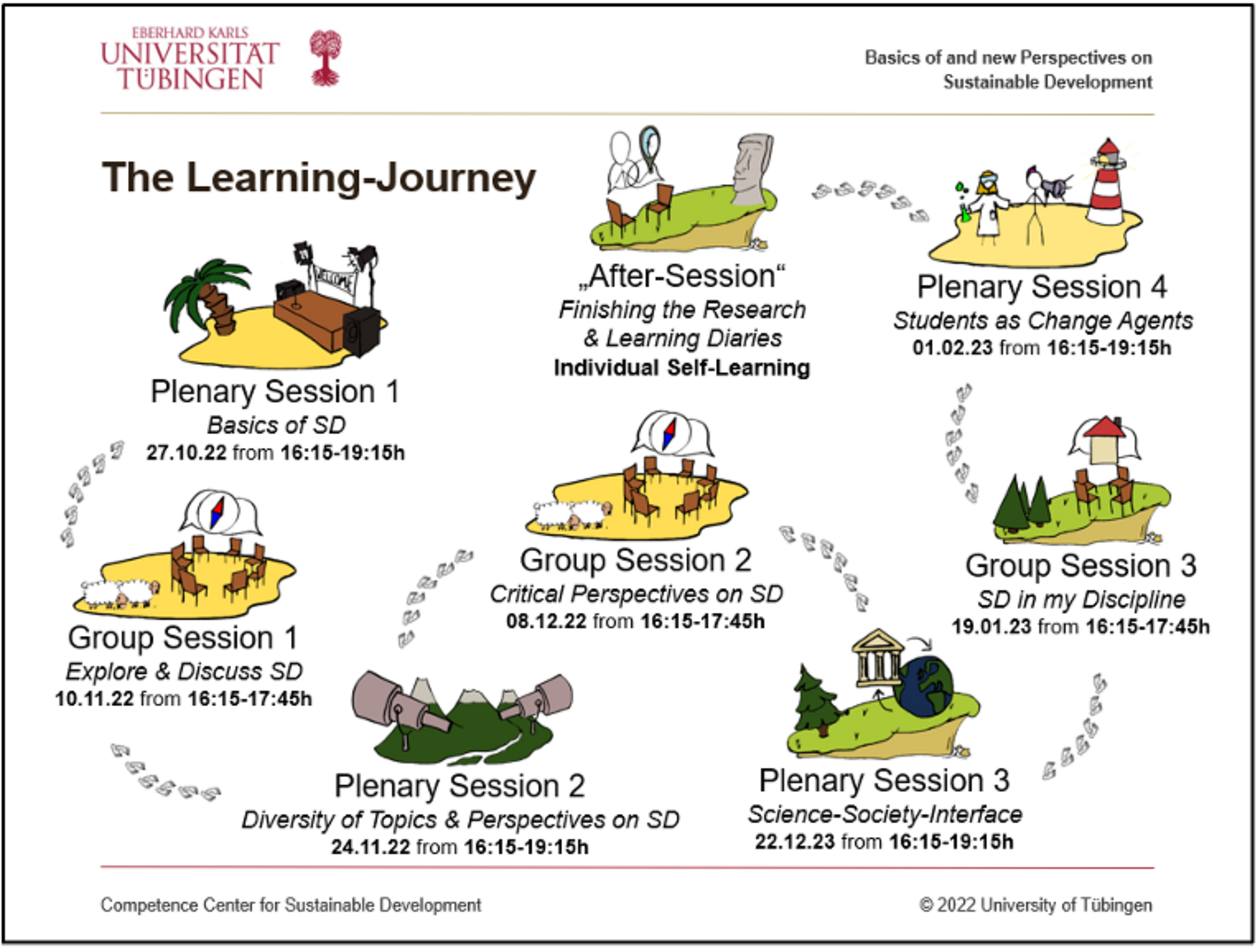
Below, the figure "The Learning Journey" provides a structural overview of the learning journey.
Between the individual sessions, self-study phases were implemented for individual consolidation and for the preparation of one's own learning and research diary which functions as a record of achievement.
The conception phase as well as the first run of the course in the winter semester 2021/22 were financially supported as a project "Digital learning for Sustainable Development with the University of Tübingen (DLSD)" by the Ministry of Environment, Climate and Energy Baden-Württemberg. This enabled a professionally oriented conception, implementation and scientific monitoring as well as evaluation of the modular digital learning journey. The offer creates spaces for teaching basics and current topics that are discussed in the context of sustainable development. Regarding the aspect of holistic education for sustainable development, the event includes interactive, participative and reflective elements (e.g. collaboration in small groups, individual learning and the research diary). In this way, participants are encouraged to learn and reflect globally, to think critically and to act responsibly in the ideal of sustainable development.
To strengthen the diversity of perspectives in the program design, lecturers from various disciplines as well as external experts from relevant professional fields are involved. Both regional and global perspectives - ranging from the Tübingen region to countries of the Global South - are systematically integrated into the course format.
Students are key actors and potential multipliers for Education for Sustainable Development (ESD) - not only in their educational and professional pathways, but also as active members of civil society. The project therefore seeks to familiarize students, as future agents of change, with the core contents of sustainable development and to strengthen their competences for design, impementation, and transformative action.
The inter- and transdisciplinary online course is open to students from all academic disciplines and is designed to accommodate 300-500 participants per semester in the long term. Its digital format and English-language instriction make it particularly accessible to students from the University of Tübingen's international partner institutions.
Project duration:
April 2021 to March 2022
IZEW Team and contact persons:
Prof. Dr. Thomas Potthast – project lead
Dr. Diana Grundmann – project coordination
Amelie Schönhaar – staff member (research assistant)
Florian Kellner – staff member (research assistant)
Jasmin Goldhausen – staff member (research assistant)
Funding:
Funded by the „Glücksspirale of the Ministry of the Environment, Climate and Energy Baden-Württemberg“ (Concept development and Testing).
Summer Semester 2022: financial support by the Competence Centre for Sustainable Development, University of Tübingen