

23.01.2025
Workshop about “Intervention Studies in Pedagogical Construction Grammar”
Interdisciplinary international exchange in Tübingen.
By Eleni Kanli
Workshop on “Intervention Studies in Pedagogical Construction Grammar” – An Interdisciplinary International Exchange in Tübingen
By Eleni Kanli
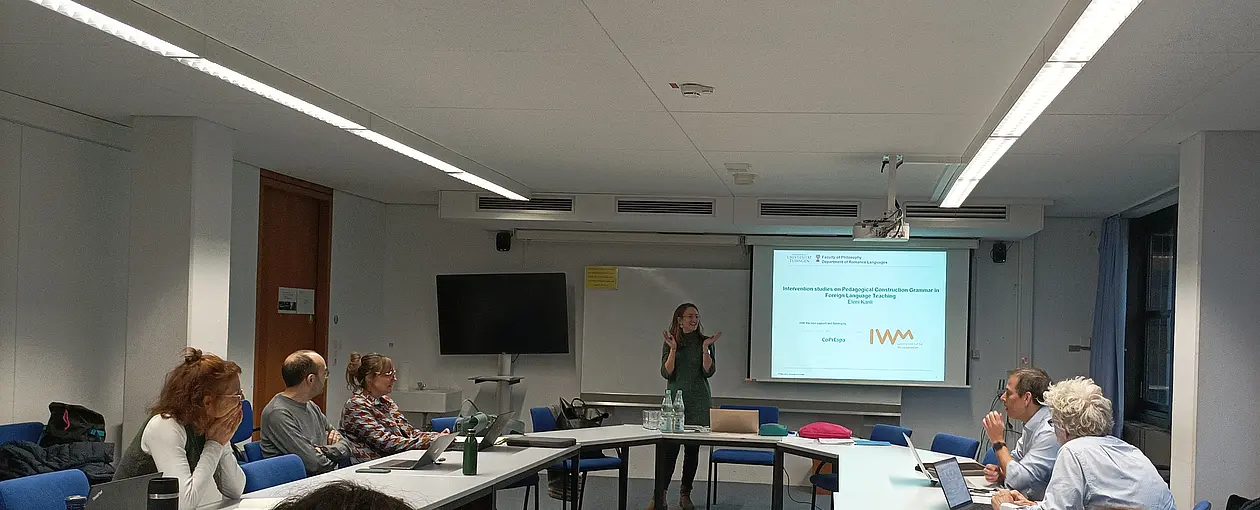
On December 2024, Tübingen hosted a workshop organized by the LEAD member Eleni Kanli and funded by the IWM in Tübingen and the CoPreSpa scientific network. The event brought together international experts from Tübingen, Barcelona, Navarra, Freiburg, Mannheim, and Salzburg, and focused on intervention studies exploring the effectiveness of pedagogical construction grammar and digital supported learning in foreign language teaching.
The workshop centered around a linguistic approach that challenges traditional grammar theories, such as Chomsky’s universal grammar, by emphasizing the role of form-meaning pairs along a lexicon-grammar continuum. Drawing on the work of, among others, Goldberg (2006), De Knop & Gilquin (2016) and Boas (2022), it promoted the understanding of foreign language learning as a dynamic process of construction learning, situated in authentic communicative contexts. This approach goes beyond the already established teaching of fixed ‘chunks’, such as “I don’t know”, that are helpful for daily communication. Instead, it is addressing constructions of different degrees of schematicity and complexity, for example [I don’t + verb]. This allows learners to use constructions productively during communication.
The workshop served as a platform for interdisciplinary exchange, particularly strengthening the dialogue between linguistics and educational sciences. Participants explored the opportunities and challenges of applying intervention studies in real-world foreign language teaching and considering students’ differences, whether in L1 teaching in primary schools or in instructed L2/L3 learning of English or Romance languages in secondary school. The interplay between the dynamic linguistic approach of construction grammar and intervention studies can provide a deeper understanding of the role of constructions in second or additional language acquisition, as well as their application and evaluation in authentic teaching material. The workshop reinforced the value of dialogue and shared knowledge in enhancing language teaching methodologies across different languages and educational levels. We are looking forward to further exchange.
Share


