News
19.11.2025
JUNO experiment delivers first physics results two months after completion
University of Tübingen is involved in the construction and operation of the underground neutrino observatory in southern China– Experiment aims to investigate electrically neutral elementary particles of very little mass
The Institute of High Energy Physics (IHEP) of the Chinese Academy of Sciences held a press conference in Jiangmen City on 19 November 2025 to announce the successful completion of the Jiangmen Underground Neutrino Observatory (JUNO) and the release of its first physics results. After more than a decade of design, construction, and international collaboration, JUNO has become the world’s first next-generation, large-scale, high-precision neutrino detector to begin operation.
Early data show that the detector’s key performance indicators fully meet or surpass design expectations, confirming that JUNO is ready to deliver frontier measurements in neutrino physics. A detailed paper describing the detector performance has been submitted to Chinese Physics C and was posted on the arXiv preprint server on November 18.
At the press conference, Prof. Wen Liangjian, physics analysis coordinator of the JUNO Collaboration, presented the experiment’s first physics results.
Using data collected between August 26 and November 2, 2025—just 59 days of effective data after the start of operation—JUNO has already measured the so-called solar neutrino oscillation parameters, θ12 and Δm221, with a factor of 1.6 better precision than all previous experiments combined.
Measurements are going as planned
These parameters, originally determined using solar neutrinos, can also be precisely measured by reactor antineutrinos. Earlier results from the two approaches showed a mild 1.5-sigma discrepancy, sometimes called the solar neutrino tension, hinting at possible new physics. The new JUNO measurement confirmed this difference, which can be proved or disproved by the JUNO experiment only using both solar and reactor neutrinos.
A detailed paper reporting these findings has been submitted for publication and was posted on the arXiv preprint server on November 18.
“Achieving such precision within only two months of operation shows that JUNO is performing exactly as designed,” said Yifang Wang, JUNO project manager and spokesperson. “With this level of accuracy, JUNO will soon determine the neutrino mass ordering, test the three-flavour oscillation framework, and search for new physics beyond it.”
JUNO is a major international collaboration led by the Institute of High Energy Physics (IHEP) of the Chinese Academy of Sciences. The project involves more than 700 scientists from 74 institutions across 17 countries and regions. “As Chair of the JUNO Institutional Board, I am proud to see this global effort reach such a milestone. JUNO’s success reflects the commitment and creativity of our entire international community.” said Marcos Dracos of the University of Strasbourg and CNRS/IN2P3 in France.
“The scientific outcome announced today witnesses how fruitful the decade long effort of the JUNO Collaboration has been to assemble a state-of-the-art detector, incorporating many cutting-edge technical solutions, that will dominate the landscape of neutrino physics over the next years, providing results of exquisite precision. Many factors contributed to this success, among which the convergence of experience and expertise in liquid scintillator detectors and related analysis techniques—brought together by groups from around the world—was surely pivotal in achieving JUNO’s unprecedented level of performance”, added Gioacchino Ranucci of University and INFN of Milano in Italy, deputy spokesperson of JUNO.
History of the experiment
The concept of JUNO was proposed in 2008 and received approval and funding from the Chinese Academy of Sciences and the Guangdong Provincial Government in 2013, followed by international contributions in 2014. Civil construction of the underground laboratory began in 2015, with detector installation starting in 2021 and completing in December 2024. After filling the detector with ultrapure water and 20 kilotons of liquid scintillator, JUNO began physics data taking on August 26, 2025.
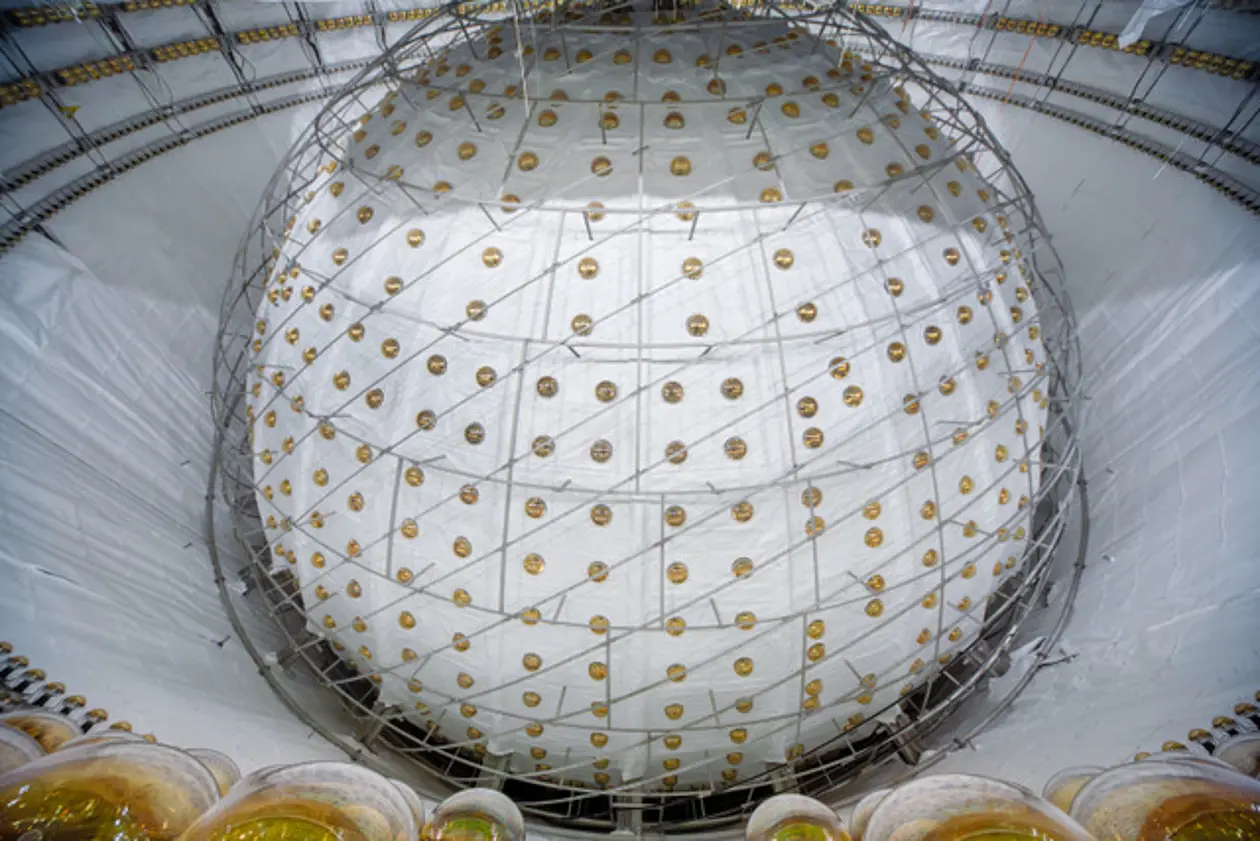
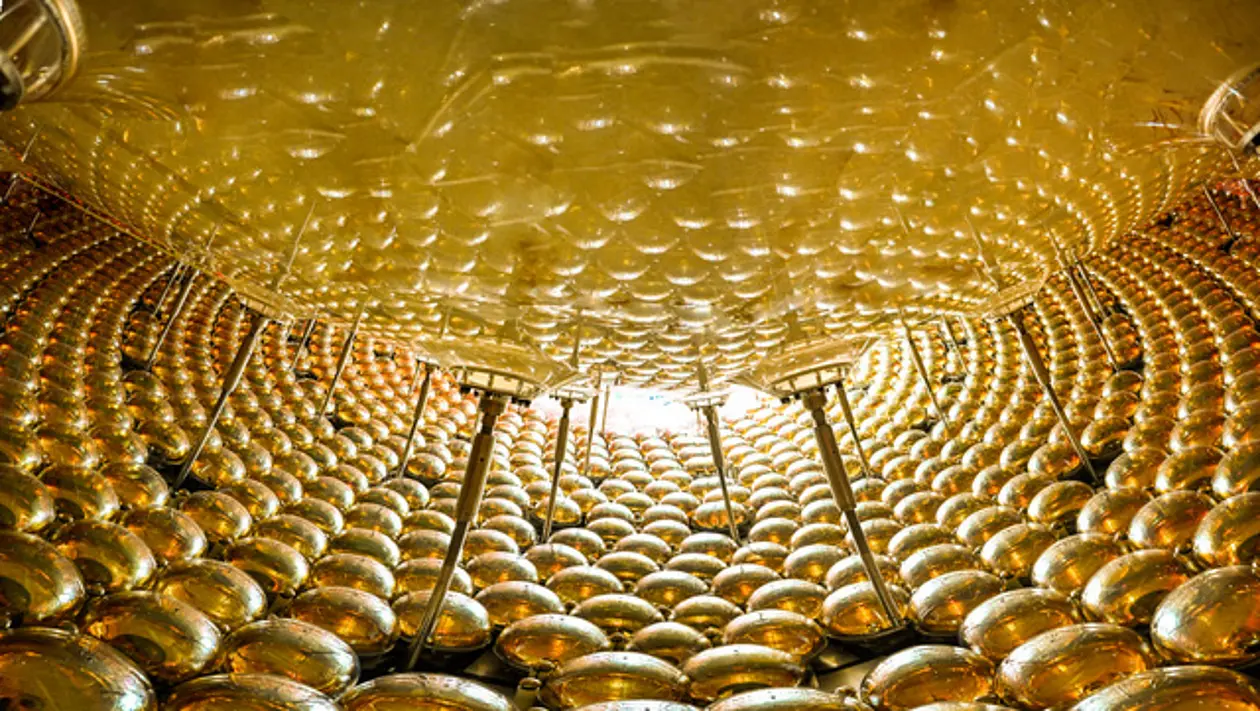
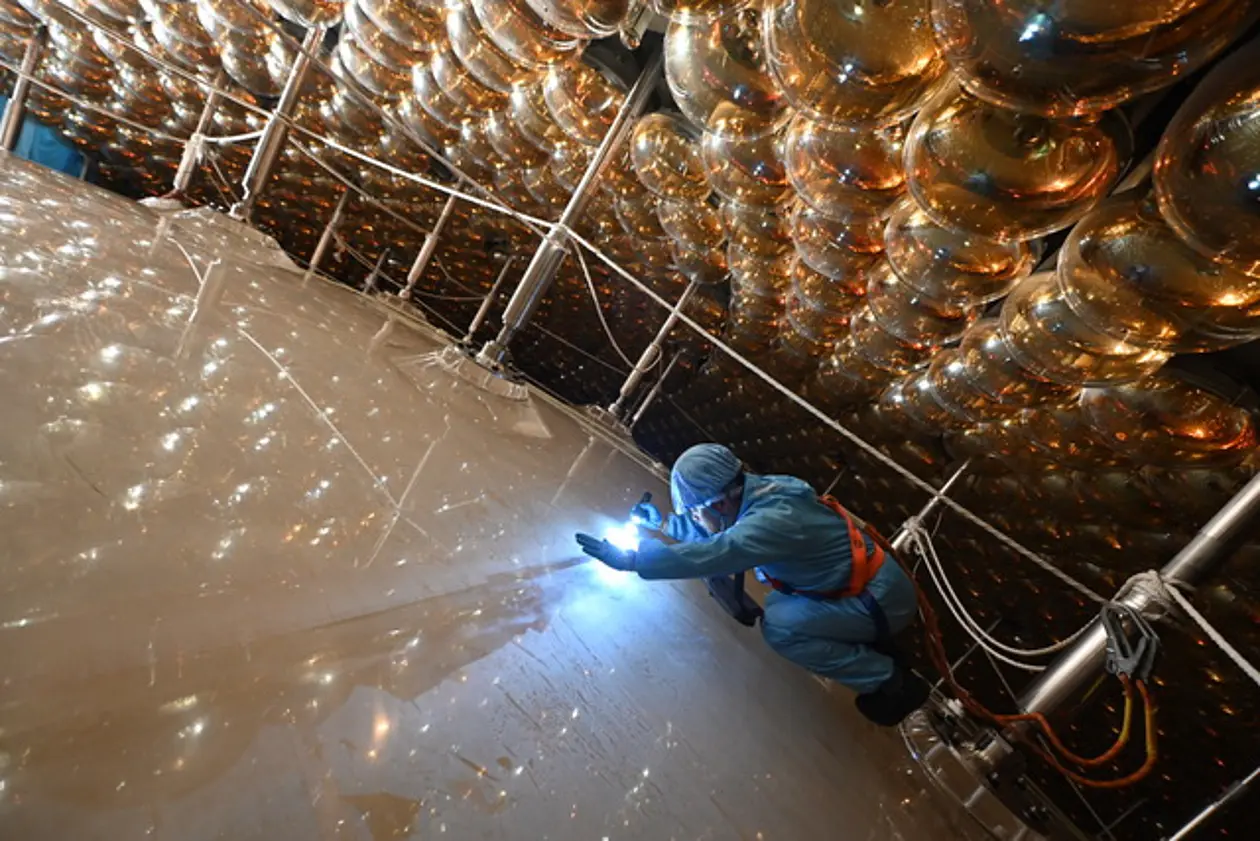
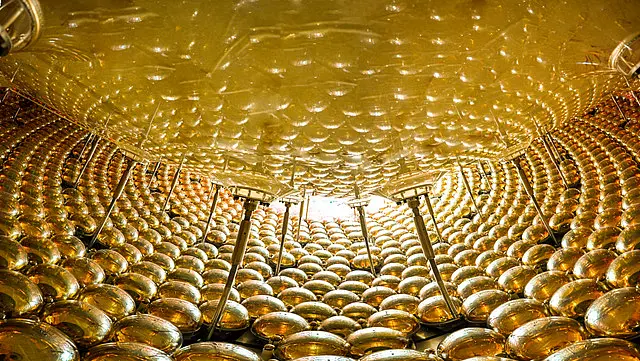
Years of dedicated R&D led to breakthroughs in key technologies, including high-efficiency photomultiplier tubes, ultra-transparent liquid scintillator, low-background materials, and precision calibration systems. At the heart of the experiment is a 35.4-metre-diameter acrylic sphere holding 20,000 tons of liquid scintillator, viewed by more than 20,000 large and 25,000 small photomultiplier tubes immersed in a 44-metre-deep water pool for shielding and muon tagging.
With its unprecedented detection sensitivity, JUNO will determine the neutrino mass ordering and measure oscillation parameters with sub-percent precision. It will also study solar, atmospheric, supernova, and geoneutrinos, and search for physics beyond the Standard Model. Designed for a scientific lifetime of about 30 years, JUNO can be upgraded into one of the world’s most sensitive detectors for neutrinoless double-beta decay, probing the absolute neutrino-mass scale and testing whether neutrinos are Majorana particles.
“JUNO will continue to produce important results and train new generations of physicists for decades to come,” said Jun Cao, director of IHEP and JUNO deputy spokesperson.
Press release of the JUNO Collaboration
Several German research groups are participants in the collaboration
German participation in JUNO includes groups from the University of Hamburg, Johannes Gutenberg University Mainz, the University of Tübingen, RWTH Aachen University, the Technical University of Munich, and the GSI Helmholtzzentrum für Schwerionenforschung.
Prof. Dr. Tobias Lachenmaier from the University of Tübingen is spokesperson for the research group “Precision Neutrino Physics with JUNO”, funded by the German Research Foundation (DFG). This group coordinates the contributions of German scientists, both in the construction of the detector and in the measurement phase that has now begun.
“A team from the University of Tübingen has been involved since JUNO was founded ten years ago,” says Lachenmaier. “We are proud that the expertise we have built up over many years has now led to success in a highly international collaboration.” The neutrino researcher emphasizes that JUNO's scientific questions go far beyond the state of the art in fundamental particle physics. “For example, we were able to show how JUNO can search for a specific form of dark matter in our universe in addition to measuring neutrinos.”
In addition to DFG support for Research Unit FOR 5519, JUNO research in Germany has been funded by the Helmholtz Association’s recruitment initiative.
Contact:
Prof. Dr. Tobias Lachenmaier
University of Tübingen
Department of Physics
tobias.lachenmaierspam prevention@uni-tuebingen.de