Uni-Tübingen

Kastanienhof – Dialogue

Marcus Hölz, AiS gGmbH director, next to big bags of biochar

Since 2025, the University of Tübingen has been operating a living laboratory for research into sustainable pyrolysis and biochar processes, working in cooperation with Arbeit in Selbsthilfe inklusiv gGmbH (AiS) at the Kastanienhof in the village of Bodelshausen. The aim is to pursue application-oriented research issues and to open up new avenues for sustainable energy and the circular economy.




What is pyrolysis?

Pyrolysis is a process in which biomass - such as wood waste, green waste, and other plant residues - is heated in the absence of oxygen. Without oxygen, the material does not burn, but instead produces:

  • Biochar - this can be reused as a raw material for soil improvers.
  • Pyrolysis gases – these are fed back into the combustion system and replace an external fuel.
  • Thermal energy – this is fed into the Kastanienhof's heating system and used to heat buildings and greenhouses. 

Pyrolysis allows the carbon contained in the biomass to be permanently bound in solid form instead of being released into the atmosphere as CO₂. If recycling cycles are closed during pyrolysis, this process is not only climate-neutral, but  carbon-negative.


Project background

The University of Tübingen achieved excellence status back in 2012 with its Research – Relevance – Responsibility concept. Research, teaching, and knowledge transfer in business and society form the foundation of this strategy. In line with the knowledge triangle of education, research, and innovation, the University sees itself as an active shaper of social development and sustainable transformation.

The “Bunte Wiese” initiative for the use of grass clippings gave rise to the idea of using pyrolysis to converting biomass from gardens into valuable biochar and sustainable pellet fertilizers. The concept was successfully tested with AiS inklusiv gGmbH in a feasibility study and now forms the basis for the living laboratory at the Kastanienhof.


Project partners AiS and the Kastanienhof

The project partner Arbeit in Selbsthilfe inklusiv (AiS) gGmbH in Mössingen enables people with disabilities to participate in working life. AiS maintains the orchards in the surrounding communities and carries out tree pruning and mowing work. People with and without disabilities process the harvested fruit into various products. At the Kastanienhof in Bodelshausen, AiS runs a farm shop, a farm café, an ornamental plant nursery, and a farm. The Kastanienhof also includes two residential buildings for people with and without disabilities, an education center for volunteers in government-run schemes (organized by the KBF), an indoor riding arena for therapeutic riding, and stables for the animals.


What is a living laboratory?

A living laboratory is a research facility where academic findings are obtained and tested directly under real-world conditions. Researchers work with partners from industry, local authorities, businesses, and citizens to develop concrete solutions to social challenges. The Kastanienhof living laboratory combines environmental, economic, and social aspects. Research takes place not in a lab, but in everyday life - with results for the environment, the economy, and society.


Closed recycling loops and climate-neutral energy

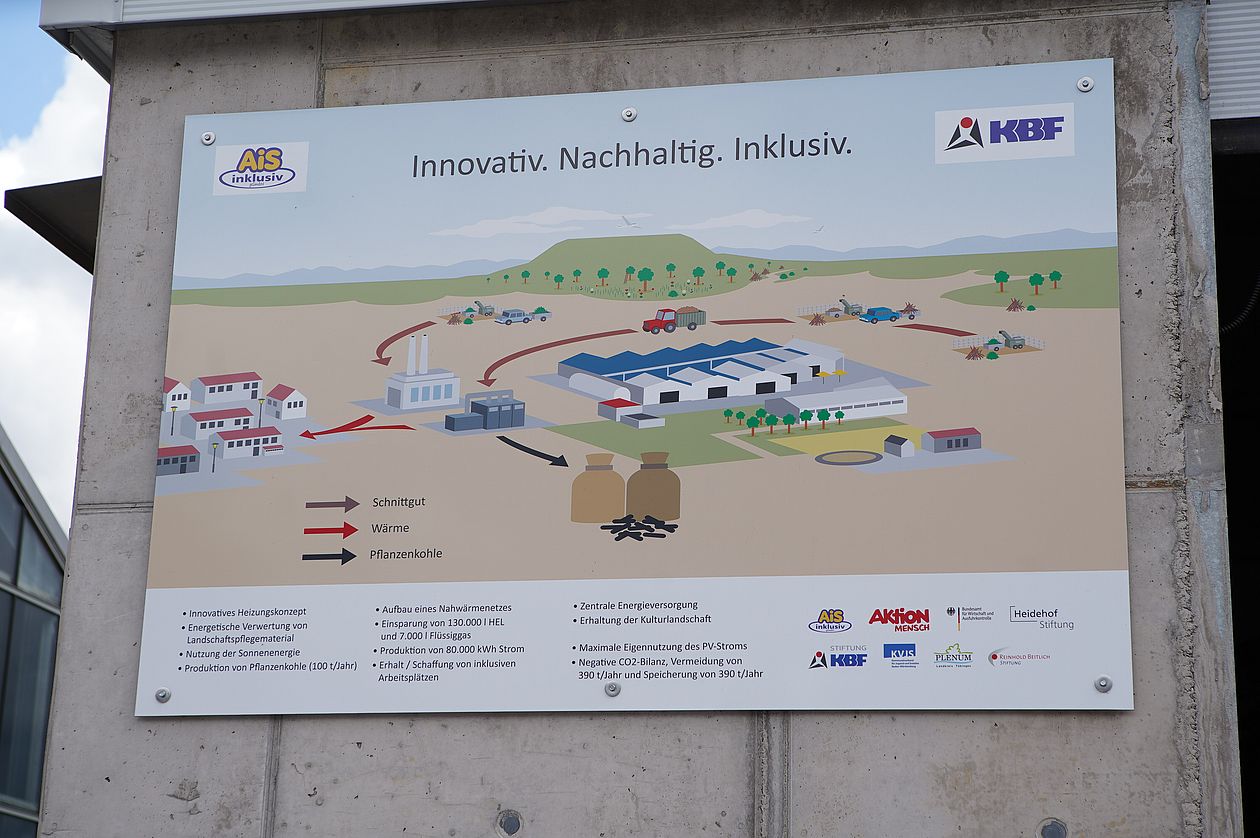
In the living laboratory, biomass from tree cuttings from orchards and wood residues from forestry is utilized. The pyrolysis plant converts these materials into biochar, which serves as a soil conditioner and fertilizer base.

At the same time, the pyrolysis plant supplies heat for the Kastanienhof's local heating network, which includes residential buildings, a farm shop, greenhouses, and a café. This creates a closed cycle of energy generation, resource conservation, and agricultural application. The Kastanienhof currently saves 780 tons of CO₂ annuall


What is biochar and what is it used for?

Biochar is the solid end product of pyrolysis. It consists of pure, stably bound carbon and has a highly porous structure - similar to a sponge. This structure makes it an ideal storage medium for water and nutrients. In addition, biochar binds carbon stably for hundreds of years, thereby reducing greenhouse gas emissions.

Biochar can be used in a variety of ways: 

  • Agriculture: Biochar improves soil quality, replaces fertilizers, and thus promotes sustainable development. Because it increases water retention capacity, it can protect plants from drought or wet conditions.
  • Forestry: Biochar is used for environmentally-friendly reforestation and also helps prevent forest fires, as biochar is highly resistant to combustion.
  • Construction industry: Biochar can be used in a climate-friendly way as an additive in building and insulation materials. 

Animal husbandry: Biochar can be used, for example, as a healthy feed additive that binds bacteria and methane, or as climate-friendly bedding in stables


Practical research and inclusion - sustainability in action

The Pyrolysis Plant Real-World Laboratory project opens up a wide range of opportunities for the University and its researchers to live up to their self-imposed standards and fulfill their social role (research, relevance, and responsibility). In the real-world laboratory, innovative projects related to biochar can be developed and carried out, demonstrating the complexity and contribution of this technology in a wide variety of fields: industrial transformation, ecology, sustainability, CO2 sequestration, climate change, soil improvement, biodiversity, closing material cycles, cultural landscape, citizen science, and inclusion. The cooperation promotes the social and professional participation of people with disabilities and creates new opportunities for diverse encounters.


Contact

Do you have any questions, ideas, or would you like to collaborate with us?

Please contact us at mitwirkenspam prevention@uni-tuebingen.de