
09.01.2026
Graveler Game Festival 2025
From November 13 to 16, 2025, the Graveler Game Festival in Tübingen brought together international experts, students, and creative minds to shape the future of game-based learning. In a conference and a 48-hour game jam, participants from Tübingen, Germany, Europe, Latin America, and Africa developed a total of 16 serious games on socially relevant topics. The festival impressively demonstrated the educational and transformative potential of games in higher education.
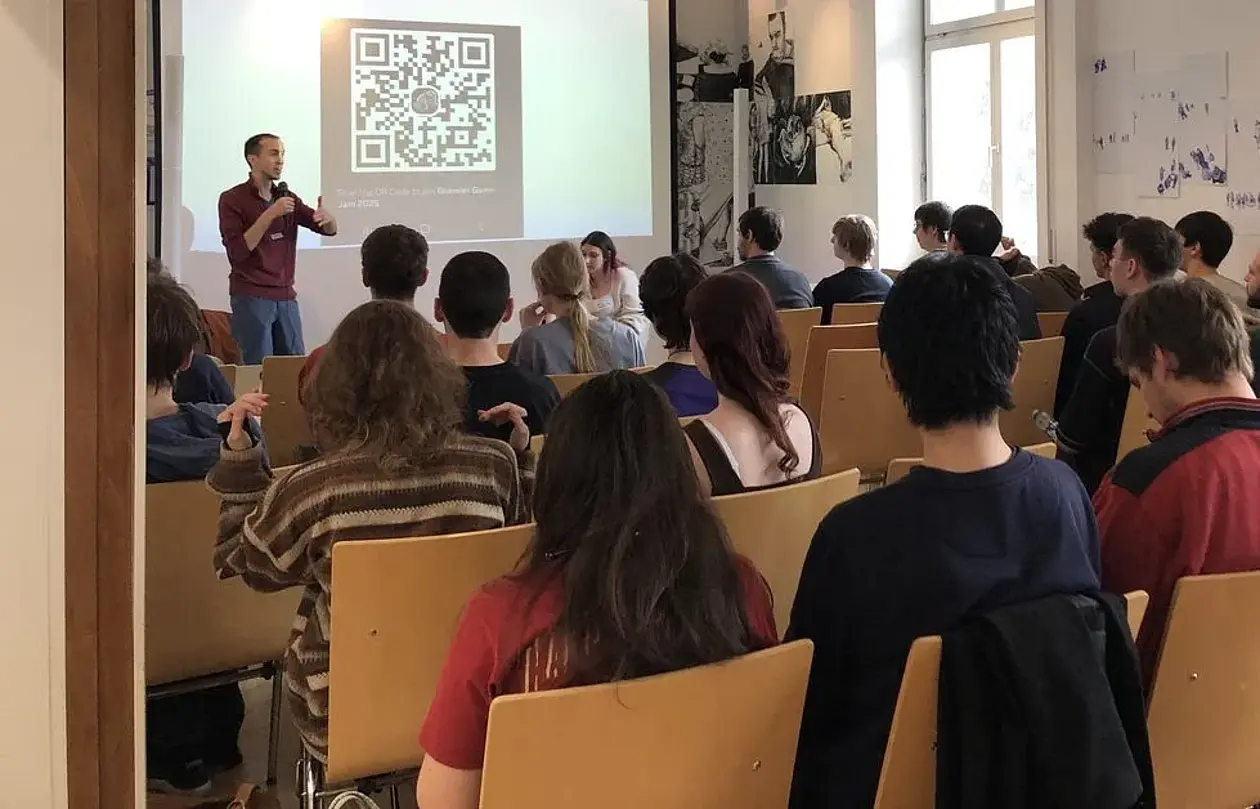
The Graveler Game Festival took place from November 13 to 16, 2025, as a collaboration between the areas of Global Awareness Education (TRACS) and Digital Humanities of Tübingen University, and the Franco-German Cultural Institute (ICFA) Tübingen. The four-day event, with 92 participants, began with a conference that brought together experts from higher education, the games industry, and politics with students, lecturers, and researchers to discuss the future of game-based learning in higher education through keynote talks and workshops.
Over the following three days, things started to take shape: A total of 55 participants (primarily students from six universities as well as researchers and freelancers), supported by seven mentors (especially from Mexico, Romania, Italy and Uganda), formed teams to develop serious games within 48 hours. 47 participants worked on site in Tübingen, while one team of 8 participants was based at Makerere University in Uganda. As part of this game jam, participants were presented with four sponsored challenges, including topics such as digital cultural heritage, political and ethics education, citizen science, and educational games. The teams received on-site support from experienced mentors in the areas of game narrative, graphics, audio, and software architecture and ultimately developed a total of 16 serious games. You can get an insight into these games here: https://itch.io/jam/graveler-game-jam-2025/entries
An initial evaluation of participant feedback showed strong interest in the pedagogical and transformative potential of the games, and no team developed a game without a deliberate learning objective. Regarding collaboration, 100% of respondents reported receiving helpful feedback from team members, 76.7% from non-team members, and 63.3% from experienced mentors. 50% of respondents indicated that they planned to further refine their games and expand them with additional content after the event. The University of Tübingen was strongly represented over the four days with a total of 67 registrations.
Coverage of the Graveler Game Festival can be found here:
https://www.swp.de/lokales/tuebingen/game-festival-in-tuebingen-in-48-stunden-zum-fertigen-spiel-78…