

attempto online
09.07.2025
Pioneering Circular Economy in Organic Radical Electronics
New Research Demonstrates Reusable Substrates for Next-Generation Nanostructures Using Water
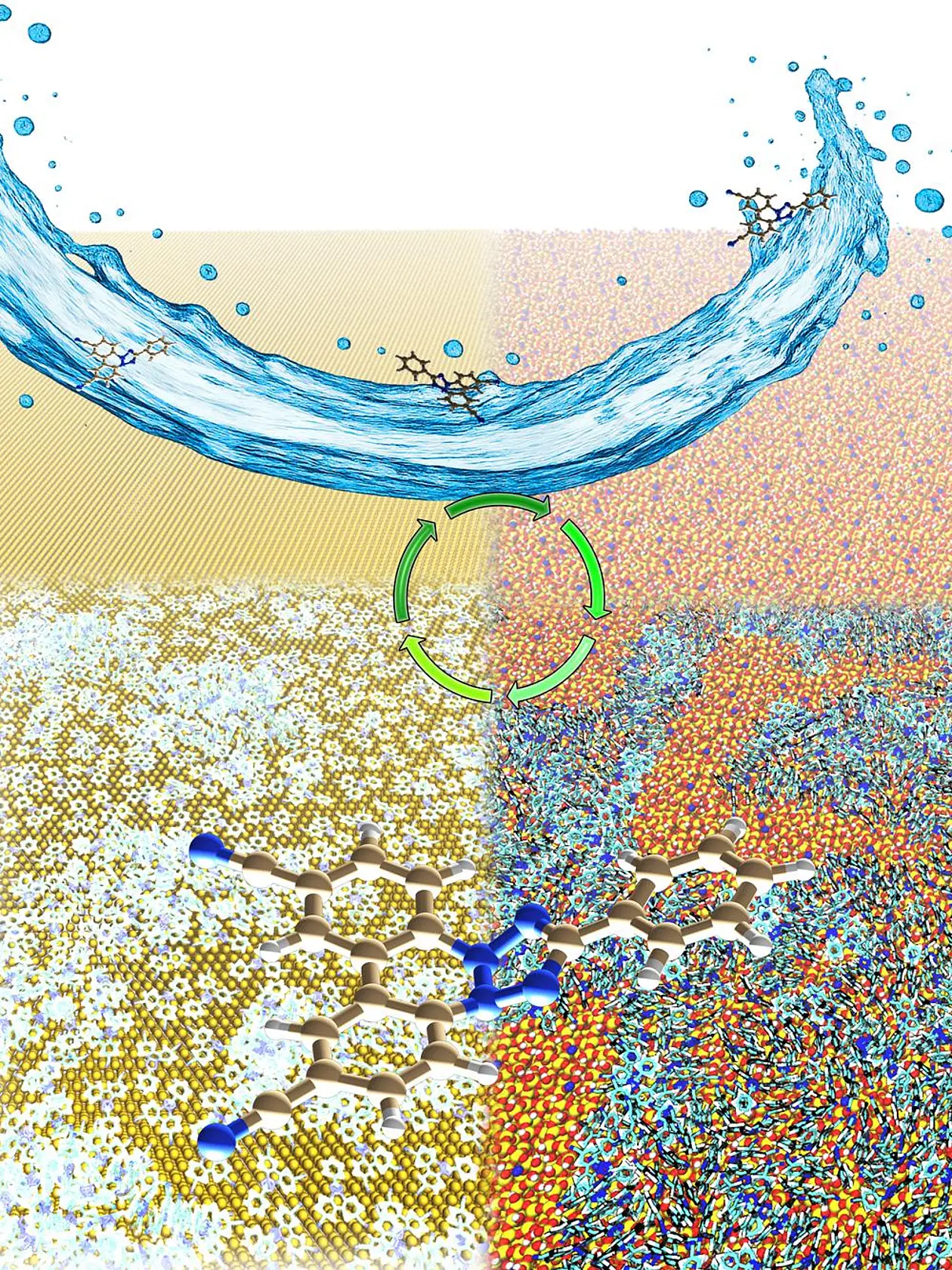
Researchers at the University of Tübingen’s Institute of Physical and Theoretical Chemistry have unveiled a groundbreaking approach to fabricating three-dimensional (3D) magnetic nanostructures that not only retain their crucial properties but can also be precisely removed with distilled water, allowing for the reuse of expensive substrates. This innovative method marks a significant stride towards addressing the escalating global electronic waste (e-waste) problem and championing the principles of a circular economy in electronics manufacturing. The study has been published in the journal Advanced Functional Materials.
Miniaturisation has driven the rapid development of electronic devices, making smartphones, smartwatches, and Bluetooth headphones indispensable. However, this growth has led to urgent sustainability and ecological concerns, with global e-waste reaching an unprecedented 62 billion kilograms in 2022, and only a small fraction officially collected and recycled. Reuse is identified as a more efficient way to reduce e-waste, with significant positive impacts on the economy, environment, and health.
The new research focuses on producing innovative 3D nanostructures using a chemically stable and thermodynamically robust S = 1/2 4,4′-dicyano-2,2′-biphenylene-fused tetrazolinyl radical (see figure). These nanostructures are grown on interdigitated gold-silicon dioxide hybrid surfaces, which are technologically relevant materials for devices.
The study successfully demonstrates several key capabilities:
- the growth of radical nanostructures that retain their magnetic properties,
- the ability to adjust their morphology and size,
- selective removal of nanostructures from specific substrate regions using distilled water,
- returning substrates to their pristine condition, making them reusable after washing.
"This work addresses the dual challenge of developing new 3D organic radical nanostructures while simultaneously considering the critical need for sustainability within the ongoing ecological transition," states Dr. Maria Benedetta Casu, one of the lead authors from the University of Tübingen. "By demonstrating that our nanostructures can be precisely removed and substrates fully restored using a simple, non-toxic solvent like water, we are paving the way for more efficient and environmentally responsible production chains in electronics". Traditionally, removing nanostructures requires aggressive chemical reagents, which are often toxic and environmentally harmful. The use of purified water represents an innovative breakthrough due to its low cost, safety, and minimal environmental impact.
Investigations using X-ray photoemission spectroscopy (XPS), molecular dynamics (MD) simulations, and first principle simulations elucidated the mechanisms behind the nanostructure properties and removal. It was found that the radical physisorbs on silicon dioxide (SiO2) but chemisorbs on polycrystalline gold, leading to different structural properties and adsorption mechanisms. Notably, gold acts as a catalyst in the water-cleaning process, enabling a shorter cleaning time on gold stripes compared to SiO2 and allowing for selective removal of nanostructures from different materials.
This research not only aims to produce innovative 3D nanostructures for next-generation technologies like spintronics and quantum computing but also strives to improve efficiency and minimize consumption, aligning with circular economy principles. This approach is particularly beneficial for expensive materials, such as gold, or patterned hybrid substrates that require complex fabrication techniques. The feasibility of substrate reuse has been demonstrated through multiple production cycles, with the recycled substrates maintaining their integrity and supporting new nanostructure growth.
This work was conducted by researchers from the Institute of Physical and Theoretical Chemistry at the University of Tübingen, in collaboration with the Tyndall National Institute and School of Chemistry at University College Cork, the Department of Chemistry at University of Nebraska, COMT–Centre for Molecular and Translational Oncology & Department of Chemical and Life Sciences and Environmental Sustainability at the University of Parma, and CNR-NANO Istituto Nanoscienze Centro S3 in Modena.
Organic Spins working group
Original publication:
Achieving Chemical Recognition, Recycling, and Circularity With Radical Nanostructures
Arkaprava Das, Ewa Malgorzata Nowik-Boltyk, Tobias Junghöfer, Elke Nadler, Farzan Gity, Paul K. Hurley, Zhimin Yang, Andrzej Rajca, Francesco Tavanti, Arrigo Calzolari, Maria Benedetta Casu
Advanced Functional Materials https://doi.org/10.1002/adfm.202504323
Further information
- Full discussion and nuanced insights into the study: A Radical Podcast
- Website of Benedetta Casu’s Organic Spins working group
Contact
Prof. Dr. Benedetta Casu
Institute of Physical and Theoretical Chemistry
University of Tübingen
benedetta.casu@uni-tuebingen.de
Tel. +49 7071 29-76252
Share


