Uni-Tübingen

Practical Tips

Moving to a new country is exciting – but let us be realistic, it can also sometimes be confusing. Here you will find essential information and tips for living in Germany and how to navigate cultural nuances and university life in Tübingen.

General Information  Cultural Hints Uni Culture Uni Facilities & Services


General Information

Discover when Germany pauses for its public holidays, how to handle its ever-changing weather, what role religion still plays, and who is eligible to savor the renowned 'German' beer. The essentials at a glance:

Public holidays

Public holidays are often associated with religious festivities, the two big ones being Easter and Christmas. Germany's national holiday, Reunification Day, is celebrated on October 3 and commemorates the constitutional unification of East and West Germany in 1990. 

People generally do not work on public holidays, with the exception of emergency services, other basic public services, and public transport. Shops are closed.

Public holidays associated with certain dates

Those public holidays associated with certain dates, such as Labor Day and Reunification Day, are always celebrated on that date, even if it falls on a weekend. In this case there is no compensatory day off on the following Monday.

Public holidays associated with days of the week

Some of the Christian holidays, for example Easter and Pentecost, are associated with days of the week. Their dates vary every year. 

For the excat annual dates, just search "Feiertagskalender Baden-Württemberg" or "public holidays Baden-Württemberg".

State public holidays

Some public holidays are national, but some vary by Federal State. In Baden-Württemberg the following holidays are legally observed:

  • New Year's Day (Neujahr), January 1;
  • Epiphany/The Three Kings (Dreikönig), January 6;
  • Good Friday (Karfreitag), date varies, normally late March to mid-April; Friday before Easter Sunday
  • Easter (Ostern) dates varies, starts on Sunday after the first spring full moon
    • Easter Sunday (Ostersonntag), date varies, first Sunday after the first spring full moon;
    • Easter Monday (Ostermontag), date varies, Monday following Easter Sunday;
  • May Day (Labor Day; Maifeiertag/Tag der Arbeit), May 1;
  • Ascension of Christ (Christi Himmelfahrt), always a Thursday, 40 days after Easter, so date varies, usually in May;
  • Pentecost/Whitsun (Pfingsten) a Sunday followed by a Monday, 50 days after Easter, so date varies, usually second half of May or June;
  • Corpus Christi (Fronleichnam), always a Thursday, 10 days after Pentecost, 60 days after Easter, so date varies, usually in June;
  • Reunification Day (Tag der deutschen Einheit), October 3;
  • All Saints’ Day (Allerheiligen), November 1;
  • Christmas (Weihnachten);
    • Christmas Eve (Heilig Abend): December 24 is not an official public holiday, but many shops close by midday and people often work only a half day;
    • Christmas Day (Erster Weihnachtsfeiertag), December 25;
    • Boxing Day (Zweiter Weihnachtsfeiertag), December 26;
  • New Year's Eve (Silvester), December 31 is not an official public holiday, but many shops close by early afternoon and people often work only a half day;

The most important (Christian) holidays in Germany, such as Easter and Christmas, each include a second public holiday. Typically, the Monday after the main celebration on Sunday is also observed as a public holiday.

Climate and weather

Tübingen is located in Europe’s temperate climate zone. This means that it has four distinct seasons, with daytime temperatures in winter averaging around -5 to 5°C (though they might fall below -10°C in extreme cases), and warm summers with average daytime temperatures around 20 to 30°C (upper 30s during heat waves). So, it can get rather cold in the winter, and quite warm in the summer. 

Humidity levels are moderate, averaging about 80 % in winter and 70 % in summer. Rain can be expected during all seasons, changing to snow in winter.  

Heating

German houses usually have central heating and are well insulated, so staying warm during winter is not difficult. At the same time, this means that homes will stay warm during heat waves as well, as air-conditioning is not common in private homes. 

To learn more about how to keep temperatures at home comfortable, please see the At home section.

Religion

Religious Communities

Germany is home to people from a wide variety of religious backgrounds and traditions. The right to freedom of religion is upheld, safeguarded not only by the German constitution but also by the Charter of Fundamental Rights of the European Union and the European Convention on Human Rights. 

For the religious communties in Tübingen (Christian, Muslim, Buddhist) and their meeting points in Tübingen, find here an Overview of the different religious congregations (German). Please see also religous student groups and explore ComeTogether - Internationals as an interreligious option for Internationals.

Christianity is still the most culturally and socially influential religion in Germany. However, as of 2025, less than half of the population are still members of a Christian church, with this number declining. So, while some people belong to a church or other religious community, many do not. Also among members, religious practice can be irregular.

  • The largest Christian communities in Germany are Catholicism and Protestantism (Lutheranism).
  • Religious communities do a lot of charity work, run schools, kindergardens and care facilities, including hospitals.
  • A majority of public holidays are based on the Christian tradition.
Church Tax 

Several religious communities e.g the Catholic and Protestant ones, have special agreements with the State. They can charge a contribution from their members through the tax system, the so-called Church Tax (Kirchensteuer). When you first register your residency in Germany, you can opt out of it. Students with low income jobs typically do not have to pay this tax at all – even if they are a member of the religious community in a civic sense.

  • Mini jobs, which are jobs earning up to 520€ per month (as of 2025), are subject to lower taxes, church tax is not applicable.
  • For jobs with monthly earnings up to €968 (as of 2025), you typically don't pay income tax or church tax. If any amounts are deducted, you can claim a refund when filing your tax return.

Religious Education

Even though many people don't actively practice a religion anymore, religious education is a still a subject in German schools. School students are taught separately according to their denomination or can choose from alternative subjects like Ethics.

  • Generally, schools in the state of Baden-Württemberg offer Catholic and Protestant Religious Education and Ethics. Some schools offer religious education for other communities, including Jewish or Muslim ones and for other Christian denominations.
  • Religious communities whose denomination is not on offer in schools often provide religious instruction on weekends or during after-school hours.

Alcohol, smoking & marijuana

Alcohol

Alcohol is legal in Germany. The drinking age is 16 for beer and (sparkling) wine, and 18 for spirits. While many people do drink alcohol, it is perfectly acceptable to refuse drinking and say so – do not feel pressured to accept alcohol or obligated to give a reason for why you don't drink. 

  • Public attitudes towards alcohol are more relaxed in Germany than in many other countries, and it is quite normal to offer wine, beer, or sparkling wine at receptions and celebrations, also in an academic setting. There will always also be non-alcoholic alternatives on offer.
  • Alcohol is sold at supermarkets, gas stations, and specialty shops. Most bars and restaurants serve alcohol; cafés sometimes do not.

Smoking

Smoking is also legal in Germany (from 18 years of age), but where you can smoke is quite restricted. This includes e-cigarettes. General regluations apply:

  • Smoking in public buildings and on public transport is prohibited.
  • Train stations have restricted smoking areas and airports have smokers' lounges.
  • Most covered spaces such as shopping centers prohibit smoking. In most of these places there are ashtrays placed right outside the door, and there are no legal requirements for keeping a certain distance from building entrances.

Accommodation - including private flats and apartments - must legally be fitted with smoke detectors for fire safety reasons, so you will likely find yourself smoking outside even when you are at home.

Regulations for smoking in pubs and bars vary between Federal States. In Baden-Württemberg, the following regulations apply:

  • Smoking areas: some bars or restaurants have designated smoking areas that must be completely closed off from the non-smoking part of the establishment.
  • (Beer) gardens or tents: smoking is allowed in open-air areas such as beer gardens and terraces, as well as in tents at popular festivals.
  • Smoking bars: small establishments with just one room can allow smoking, provided that they restrict access to adults (over 18) and do not serve hot food.

Cannabis/Marijuana

The consumation of cannabis or marijuna, is legal in Germany, and restricted under the cannabis controll bill (Cannabisgesetz). The cannabis controll bill legalises adults from the age of 18 to use and possess, as well as cultivate limited amounts of marijuana for personal use. But the legalisation of marijuana sits under strict regulation:

  • Adults in Germany are allowed to possess up to 25 grams of marijuna in public, and up to 50 grams of dried marijuana at home.
  • Adults aged 18 to 21 are object to stricter regulations concerning grams as well as THC content.
  • Adult-only, non-profit cannabis social clubs are also legal, with a maximum of 500 members. Here, marijuana is cultivated in a controlled manner and may be handed out to members for personal use. Cannabis social clubs are also object to special regulations.
  • You are not allowed to bring marijuana from outside of Germany into the country.
  • Public consumption of cannabis is restricted. Consumption is for instance prohibited in pedestrian zones between 7:00 a.m. and 8:00 p.m.. Smoking marijunana in the vicinity of schools or kindergartens is also stricly prohibited.

More information on the Cannabisgesetz can be found both on the Government website, as well as on the website of the Ministry of Health (both in German).


Cultural Hints

Drawing on insights from our international students and our experience, you find below some useful guidance to help you settle in and navigate customs in Germany that may be unfamiliar. While these tips provide a basic idea, keep in mind that every culture, including Germany's, is diverse and constantly evolving. Shaped by many different people and stories, it offers a wide range of perspectives.

Greetings and farewells

In everyday (academic) situations, like seeing a lecturer or fellow students regularly in class, meeting people on the street or elsewhere, a polite greeting and goodbye without a handshake is absolutely acceptable. In formal or official settings, e.g. you are introduced to somebody, it is often customary to offer a handshake and keep eye contact when you meet or part ways. Handshakes are equally common between men and women. Hugging is reserved for (close) friends and meeting people at informal occasions  – and also depends on how well you know each other. 

If you are unsure how to greet someone, it is perfectly fine to take your cue from what they do.

Forms of address

In English, everyone is simply addressed as you and it is often common to use first names even in formal settings (though titles like Doctor or Professor may also be used). 

By contrast German offers two distinct forms of address: the formal Sie and the informal Du. When you are not yet familiar with someone or they hold a senior position, it is polite to use Sie + surname (e.g. Frau Müller) until you are invited to switch to Du. In many university and research settings, especially among students, colleagues, or international teams accustomed to English’s informal tone, Du often comes into play quickly. Academic titles frequently give way to first name basis in day-to-day conversations. 

If you are unsure how to address someone, simply mirror the form they use with you. Below you find information for forms of address in e-mails.

'On time' matters

It is generally considered polite to be on time – whether for work meetings or social plans. If you cannot attend a meeting or event, or expect to be late, a call or email is usually appreciated. For presentations, it’s best to adhere to the agreed‐upon timeframe; or consult your lecturer beforehand if you think you'll need extra time.

Communication characteristics

Some describe communication in Germany as rather “straightforward”. In professional settings, discussions usually move swiftly to the core issue, with meetings being focused and to the point. Presentations, for example, tend to be data- and fact driven. Feedback is not always explicit, which can be confusing; if no one raises concerns, you are likely on the right track. Of course, personal styles vary widely, and not every interaction follows the patterns decribed here.  

If you're used to a more casual, relationship-building style of communication, this often topic-centered approach might feel a little blunt at first. Recognizing this as one of many valid ways to communicate can help you feel more comfortable in interactions without feeling like you have to compromise your own approach too much.

Uni Culture

Getting accustomed to university life involves more than just attending lectures: Here you'll find some essential information on campus lingo, the “academic quarter” timing, crafting polite emails, and managing class absences when you're unwell.

Uni terms

Adjusting to a new study culture also means adjusting to a new jargon – and the amount of new terms used on a day-to-day basis can be tricky to understand. Our mini-glossary explains the main terms you will hear on campus, also in Tübingen.

Rooms and Classes

  • Hörsaal Lecture hall, commonly used for large lectures.
  • Raum or Seminarraum Normal-sized classroom. Often used for Seminare and Übungen.
  • Lehrveranstaltungen – Classes or courses (for the following list see also Type of classes and ECTS for detailed study information).
    • Seminar – A smaller, discussion-based class with active participation. Comes in different levels of focus areas and different ECTS-awards.
      • Proseminar, PSThe first level of seminars, often broad and introductory.
      • Hauptseminar, HSThe next advancement after Proseminar. Smaller difference in difficulty, but usually not introductory and less broad. More demanding than Proseminar and worth more ECTS.
      • Oberseminar, OS Last, most advanced level of Seminar. Are often worth the most ECTS, have a bigger workload and are more in-depth and specialised.
    • Vorlesung, VL Lecture. Larger classes and in general professor-led with less student participation.
    • Übung – A small, interactive class centered on a specific topic or skills development. Requires active participation and regular assignments, but involves less workload than a seminar.
    • Tutorium A tutorial or practice session led by a tutor (often a more advanced student) to help with coursework and -material. Often accompanying a lecture.

Study Structure and Course Organisation

  • Vorlesungsverzeichnis Course catalog, usually available in the ALMA database.
  • Modul A course module, often consisting of multiple lectures or seminars.
  • SWS (Semesterwochenstunden) “Weekly hours per semester” for a course; a 2 SWS course meets for 2 hours per week.
  • CP/ECTS-Punkte Credits points assigned for a class based on workload, see also Recommended workload for exchange students.
  • Studienplaner mit Modulplan – “Study planner with module plan” essentially. The study planner in ALMA provides an overview of the course/degree program. Relevant for a few exchange students.

Student Administration

  • Matrikelnummer Student ID number, used for administrative purposes, personal identifier of each student.
  • Immatrikulation Enrollment, receiving official student membership at the university. See Enrollment for the process.
  • RückmeldungRe-enrollment, the registration for the next semester when you are staying for more than one semester. See Re-enrollment for the process.
  • Exmatrikulation Termination of enrollment, the official withdrawal from the university. See Termination of enrollment on how to deregister. 

Exam and Academic Work

  • Hausarbeit A term paper or writing assignment.
  • Essay/Aufsatz - An essay or short writing assignment.
  • Klausur A written exam.
  • Nachklausur A make-up exam for students who missed or failed the first exam.
  • Referat A student presentation.
  • Bestehen Passing a class, an exam or term paper.
  • Durchfallen Failing a class, an exam or term paper.

Student Life and Essentials

  • Kommilitone / Kommilitonin / Kommiliton*innen Your fellow students in the same course or degree program; from Latin commilito, and referring to university student peers in German-speaking countries.
  • Mensa The university food hall, also translates as refectory.
  • Fachschaft The student council representing a specific subject area.
Administrative Terms & Paperwork Basics
  • Fakultät refers to a central unit of the university which covers several related departments. Internationally, Fakultät often corresponds to terms such as school or college
  • Immatrikulationsbescheinigung Certificate of enrollment. Often needed for administrative purposes. See the Certificate of Enrollment FAQ on how to find it.
  • Learning Agreement (LA) – Relevant for Erasmus / CIVIS exchange students, a plan specifying the student's courses for their exchange stay. Also available as Online Learning Agreement (OLA). See Learning Agreement for details.
  • Schein Course certificate, not used anymore for exchange students; official proof of academic performance for a single course, often as paper version.
  • Semesterbeitrag The semester fee that students must pay to be or remain enrolled. See Semester Fee for the current amount for exchange students.
  • Transcript of Records Document listing all courses and grades, crucial for exchange students transferring credits. See Transcript for the typical procedure.
Common Abbreviations
  • UB short for Universitätsbibliothek, university library.
  • Bib a quick way to say Bibliothek, library.
  • Ersti short for Erstsemester, a first-semester student.
  • N.N. an abbreviation of the Latin nomen nominandum (“a name to be announced”); e.g. used in the course catalog when the lecturer for a class has not yet been assigned.
  • ÖPNV – short for Öffentlicher Personennahverkehr, local public transport.
  • Öffis – a quick way to say Öffentlicher Nahverkehr, which implies again the local public transport.
  • Bota short for Botanischer Garten, the former botanical garden on Wilhelmstraße, now as park a popular meeting spot for students during the warmer months.

Class times and the Academic Quarter

When looking through the details on your classes, you might notice the extra information next to the time stamp: c.t. and s.t. These abbreviations indicate different start‐time conventions. So, how do they work?

c.t. and s.t. are abbreviations meaning “with time” and “without time”. This indicates whether the class starts with or without the so-called academic quarter – an extra fifteen minutes. The terms abbreviate the Latin terms cum tempore and sine tempore (with time and without time). 

With time indicates that the class starts with the extra fifteen minutes: A class starting at 10:00 c.t. starts at 10:15! Without time, s.t. indicates that the class begins precisely at 10:00, on the hour.

This also has effects on when the class ends. Starting fifteen minutes later normally also means that the class ends fifteen minutes earlier, at quarter to! A standard one-and-a-half-hour class could look like this: 10:15-11:45.

The quarter system dates back when church ringing was the general method of keeping time. When the church rang, students were given 15 minutes to make it to class. It has remained a typical aspect of study culture in several European countries.

E-mail etiquette

E-mails are still primary means of communication in German university life – for topics from applications and admission to course planning and meetings with professors to name just a few. Compared with other systems, you may find e-mail correspondence in Germany, especially in academia, a bit more formal in tone and structure than you are used to. Below are a few suggestions to help you navigate these conventions.

For more information on common customs in Germany, see Cultural Hints.

E-Mails in English versus German

Writing an e-mail in English requires less formality than writing in German. In English, a common greeting phrase is the simple Dear […] with either first or full name for both formal and informal matters. If you want to sound more formal, include the title (Prof. or Dr.) and last name.
While many people in Tübingen and beyond are comfortable communicating in English, they may be accustomed to a rather formal address in e-mails, influenced by German etiquette. To be on the safe side when writing e-mails in English, you can 

  • start with Dear [Title] [First Name Last Name] or Dear [First Name Last Name].
  • If the person replies on a first-name basis, feel free to do likewise.

English still showcases only one form of address, you. In German, you also need to differentiate between the formal Sie and informal Du, and there are more types of greetings to keep track off! 

Forms of Address in German E-mails

When writing an e-mail in German to a course instructor or someone else, a relative formality is often the norm – at least when first making contact. Emails in Germany should at least include:

  • a greeting phrase, and
  • a common sign-off signature, in German often something along the lines of Mit freundlichen Grüßen [your full name]. For E-Mails in English use something like: Sincerely, Best wishes or Kind regards.

The phrase Sehr geehrte Frau  […] / Sehr geehrter Herr […] with the person's last name is a common way to start off an email conversation in German. Titles are especially common in academic settings and are often part of a formal address – for example, Sehr geehrte Frau Prof. [Nachname] or Sehr geehrter Herr Dr. [Nachname]. If the tone is slightly less formal, you can use Liebe Frau […] or Lieber Herr […] instead.

In general, once a conversation has started, successive emails might be less formal in tone.

It might appear a tricky ground to traverse, but just mirror what the professor or lecturer is doing! Start off formal in your email, and if the lecturer responds back more layed back, match them!

To-The-Point

Second, e-mails are often straight and to the point. Sticking to the subject at hand is common. Don’t be surprised if your detailed e-mail gets a brief response that nevertheless covers the key information you requested.

Courtesy

Third, it is common for replies to take a few working days, lecturers and others often juggle busy schedules and/or may need time to gather information before they can reply. Resending the same message too quickly (for example, the next day) can actually slow things down. So sit tight and your reply will arrive in time! 

If you still have not received an answer after about five complete business days – and you’re understandably worried your e-mail might have been lost – feel free to send a brief, polite reminder. And during holidays, vacations or business trips, automatic out-of-office replies will let you know when to expect an answer.

Missing a class due to illness

Presence and Absence Policies for Classes

Firstly, it generally differs between faculties and sometimes even between subjects whether students are required to physically attend each and every class. If such a policy exists, the lecturer of each class usually mentions their policy regarding illness and absence in the first class session.

As a guideline, unless you were informed differently: Regular attendance is expected in most courses – large lectures being the main exception. In many classes you may miss up to two sessions without reporting or consequences. From the third absence on, however, you should notify the lecturer and supply a valid excuse, such as a medical certificate, exam conflict or compulsory field trip.

Excessive absence may not be accepted by all lecturers. Missing a class more than two times may lead to failing that class. Please double check to be sure! 

Reporting in sick

To report sickness in a required-attendance class, email your lecturer that you are unwell. If it is the third time that you are or were absent and your lecturer accepts this absence – even if you were not sick the first two times – you usually have to include a valid reason, e.g. a medical certificate. The lecturers might report back to you with information on how you can catch up after being absent. If not, make sure to ask them or student peers what you missed.

If you are unable to take an exam due to illness, inform your lecturer as early as possible – clear and timely communication helps to avoid any issues with the exam. To keep your chances for a make-up exam, you usually need to submit a medical certificate (Krankschreibung) to both the lecturer and the examination office. Without it, you might lose that chance and risk failing the course.

See Medical certificate on how to obtain the necessary Krankschreibung. 

Students with Disabilites and Special Needs

Exchange students with chronic illnesses that may lead to more frequent absences in classes, please check out the additional guidance on adjusting study conditions to ensure you receive the necessary support.

Further support for navigating life in Tübingen

At the start of each term, the IC Advisory Course and preparatory German language courses provide practical guidance to get you started. During the term, you can

Even before arriving in Tübingen, you can join online the TÜ-VIP program, which offers intercultural classes and an introduction to the city!


Uni Facilities & Services

From libraries to lunch options, writing advice to WiFi fixes – discover further key university facilities and services! These practical campus offerings support your academic journey and make everyday student life a little easier.

Libraries

University Library

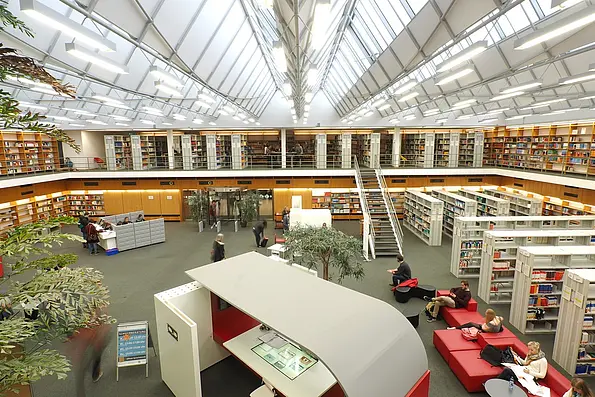
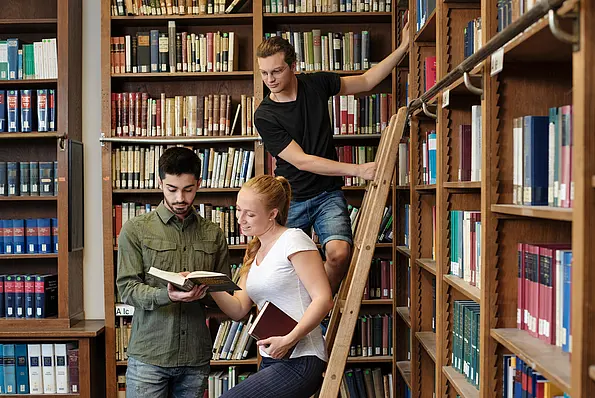
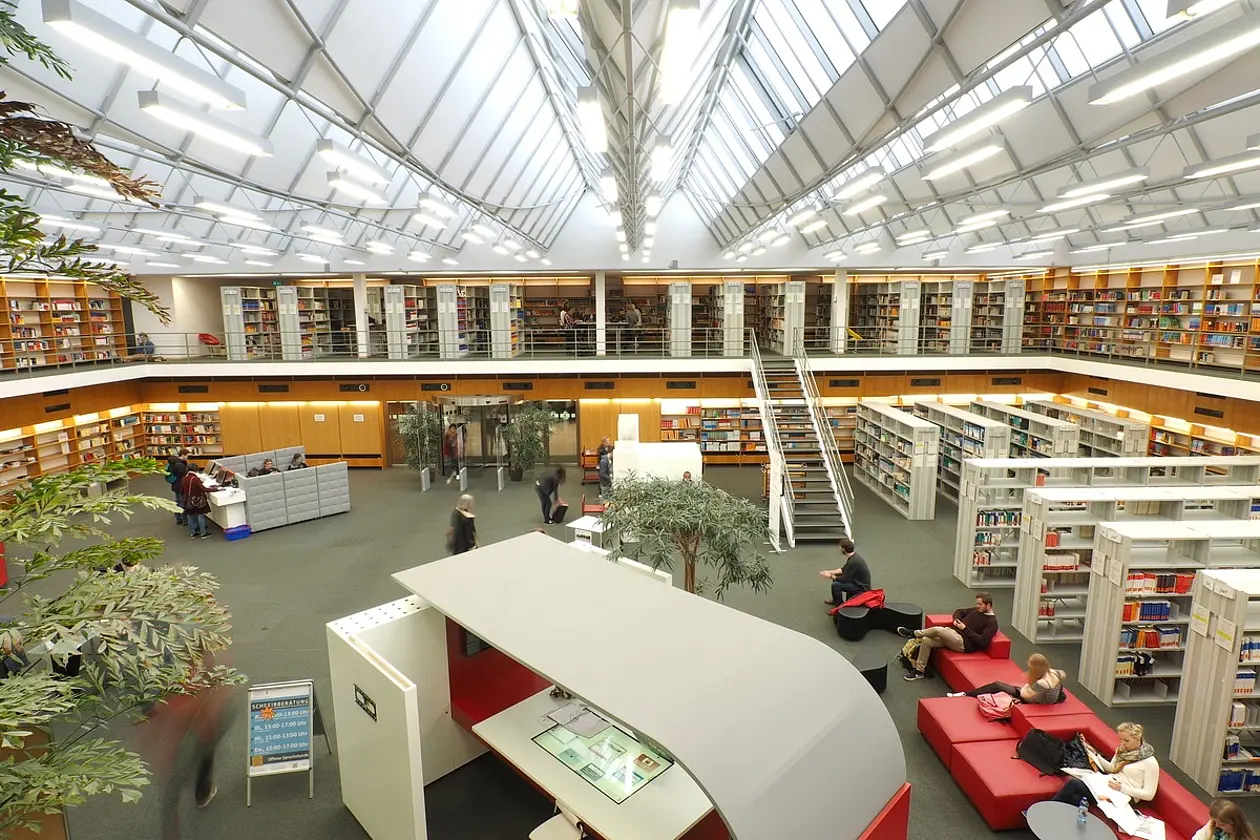
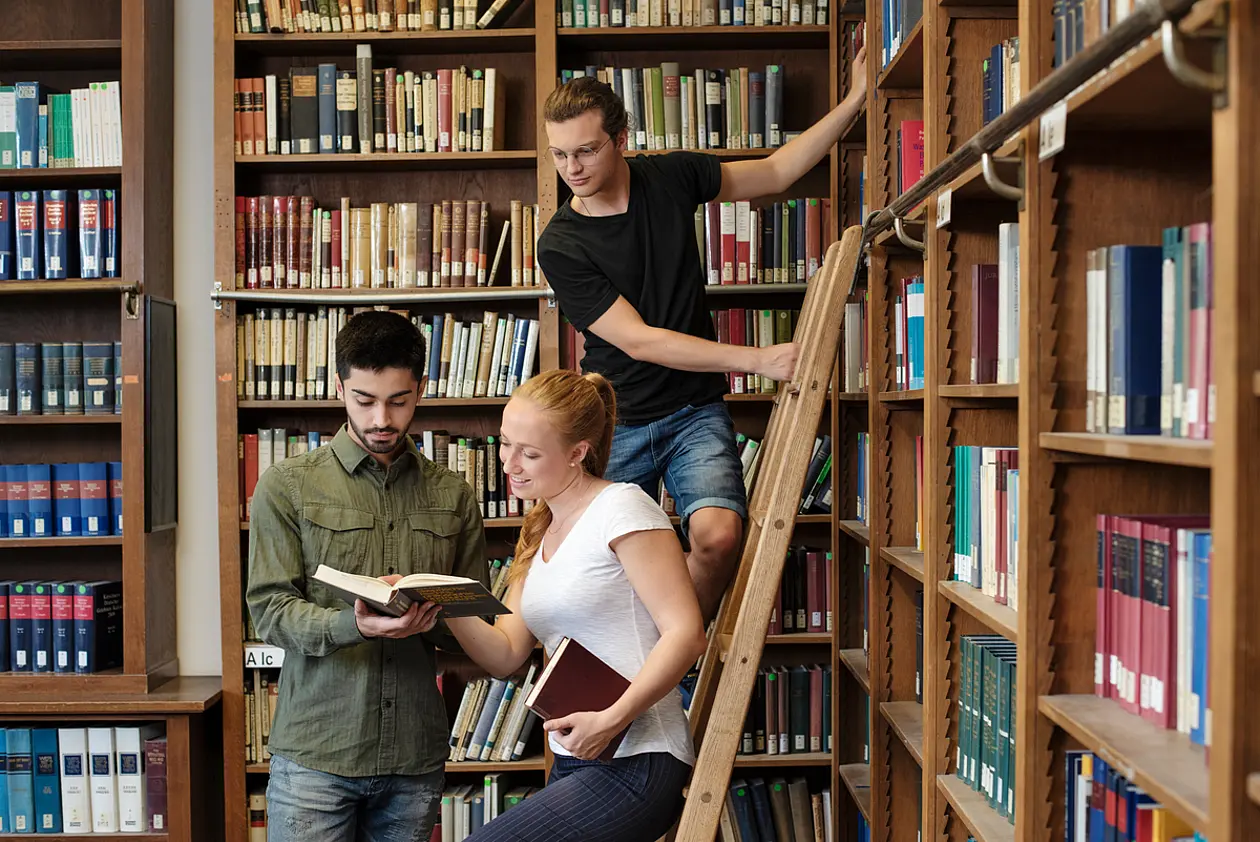
The University Library (Universitätsbibliothek, UB) on Wilhelmstraße is an essential hub for all students, offering an extensive collection of books, journals, and digital resources. It provides a variety of study environments – from quiet zones and computer labs for focused work to group spaces for collaborative projects. Guided tours and training sessions help sharpen research skills and information literacy. The library also offers comprehensive options for copying, printing, and scanning. You can access them using your student ID card at the designated multifunction devices.

Behind the lockers on the main library's ground floor you can find the only top-up machine accepting cash for student ID card charges; other top-up machines only take payments via German Giro or EC-Karte.

Among the library’s special features is the Room of Silence, created for quiet reflection. Open to all – whether for spiritual practice or a moment of silence – it offers a peaceful retreat independent of religious beliefs.

The University Library includes branches at the Morgenstelle campus for the Natural Sciences and at Castle Hohentübingen for Ancient Studies.

Departmental Libraries

Alongside the central library, the University has over 50 departmental and institutional libraries. Have a look at this library overview (German) or visit the individual departmental websites for detailed information. Located within their respective departments, they offer subject-specific resources that complement the main library. You can also print, scan, and copy documents there using your student ID card, though the available functions may vary between different libraries.

The departmental libraries are ususally Präsenzbibliotheken – reference libraries where materials are meant to be available on-site for immediate use, with limited short-term loans possible on weekends or during breaks. 

The main library (UB) also has a relatively large on-site collection (Präsenzbestand) that cannot be borrowed.

Academic writing support

The Diversity-Oriented Writing Center

Struggling to organize a term paper or facing an assignment that calls for a different approach than you’re used to? Academic writing can be demanding, even for experienced students. The University’s Writing Center provides guidance in English and German to help you strengthen the structure, style, and clarity of your work. With users from diverse academic and cultural backgrounds, the center adjusts its support to meet the different needs. Online materials in German are available for self-paced skill building.

Departmental Writing Consultations

Several departments and faculties, particularly within the social sciences and humanities, offer subject-specific support for writing papers and preparing presentations See here which departments offer these services (German). In many cases, this support is provided by trained student mentors who bring firsthand experience and practical insights.

Food options on campus


Tübingen University’s three Mensas and their smaller campus Cafeterias each offer affordable meals. Here you will learn where to find special dishes, which payment options work best and how to avoid the longest queues.

The Mensa and the Cafeterias are run by the Studierendenwerk, an organisation that Tübingen University is cooperating with to ensure students with social services. 

Refectory/Food Hall

The Mensa at German universities is the German version of a refectory. It serves warm lunch for, usually, the students and university staff. In Tübingen, it also offers meals for guests – people who normally have received a guest card.

The food assortment is varied, but there are always a reasonably priced menu of the day (Tagesmenü, often a meat dish), a vegetarian or vegan alternative (Tagesmenü vegetarisch/vegan) and other, a bit more costly dishes (Auswahlgericht) you can choose from. The buffet area, with varied food assortment ranging from greens to meat and chicken to vegan and vegetarian options, offers individual alternatives. The Mensa also serves cold beverages, along with a dessert for those with a sweet tooth. 

  Students pay a reduced price for their meals in the Mensa. It all works through the student ID card – do not forget to charge it with money in time! 

The peak time is around 12:15 - 1:15 p.m. and usually coincidences with the end of morning classes or before classes begin in the early afternoon. After the exam period and during the semester break the Mensa is less busy at noon.

The various Mensas in Tübingen

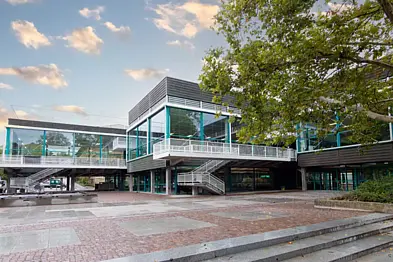
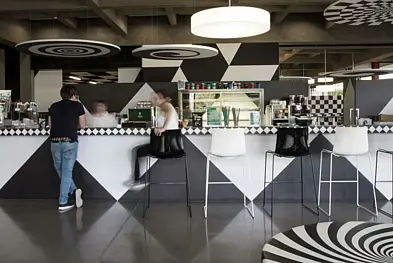
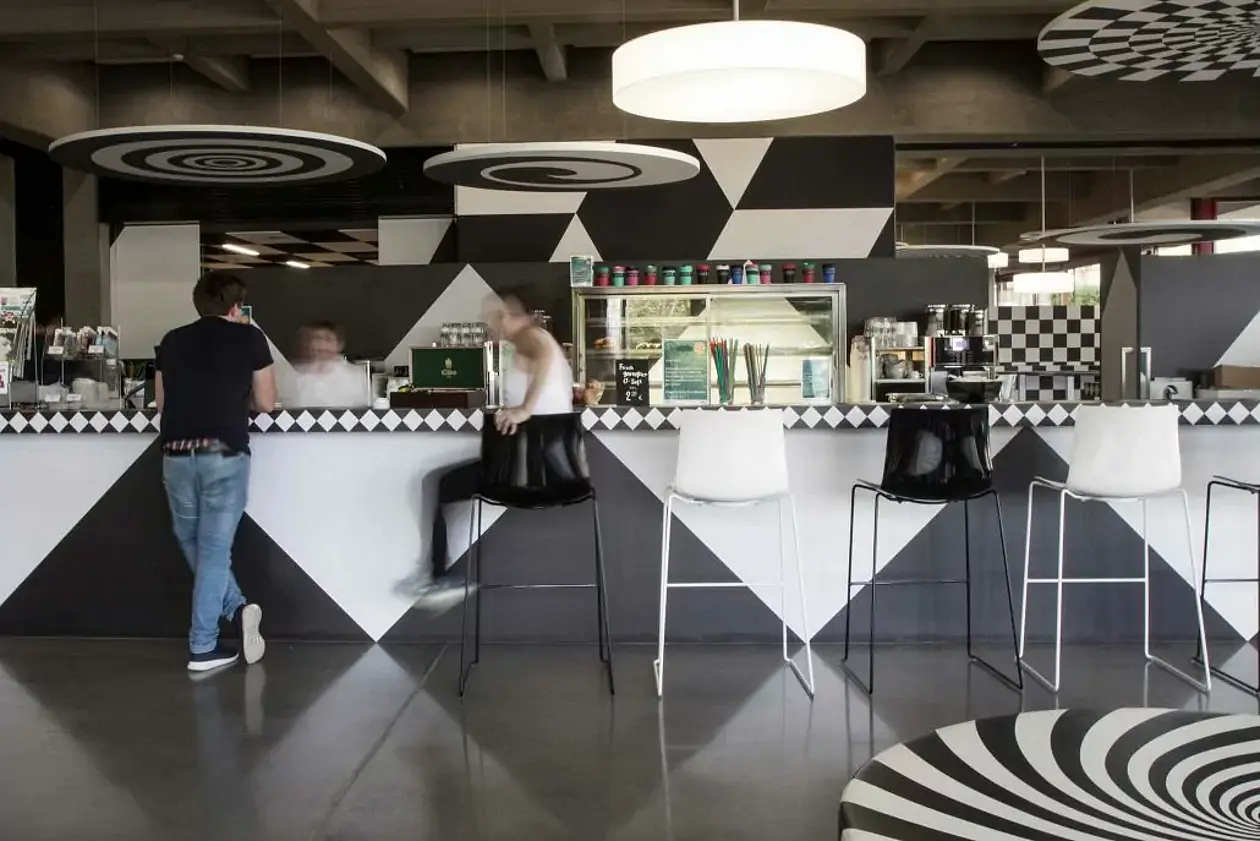
Mensa Wilhelmstraße: Newly renovated and reopened, the Mensa Wilhelmstraße is located directly opposite the university library. In addition to a lunch serving area, its cafeteria offers snacks, hot dishes and features a fancy coffee bar. The ground floor of the building seconds as a spacious study area.

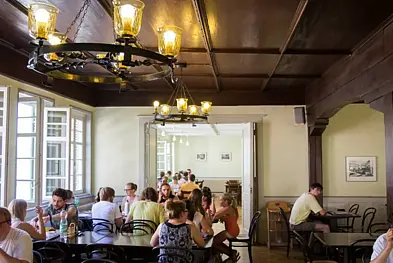
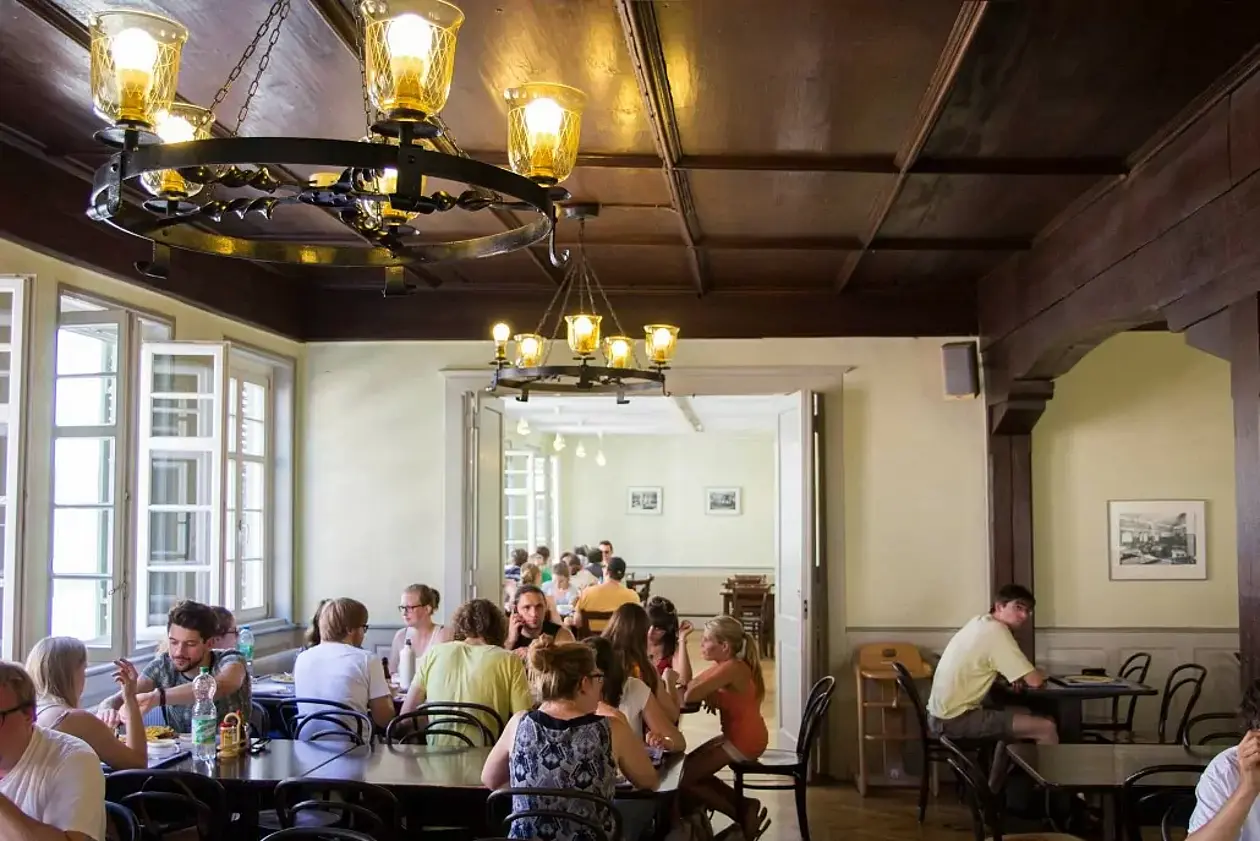
Mensa Prinz Karl: Located in Tübingen's Old Town district, the Mensa Prinz Karl is one of the oldest mensas in the country. It is a charming historical building, matching the nice atmosphere of the picturesque old town. Prinz Karl doubles as a cafeteria until afternoon.

Mensa Morgenstelle: The Mensa Morgenstelle is located on the natural sciences campus, and also offers students and staff a lot more than just lunch: You’ll find coffee, sandwiches, hot meals, and various snacks at its cafeteria, which also features a spacious study area.

Download the my-stuwe app of the Studierendenwerk Tübingen-Hohenheim for opening times and weekly menus. And find here the current menu of the Mensa Wilhelmstraße as an example!

Cafeterias

The six Cafeterias on campus are located in larger university buildings, as well as alongside the Mensas. You can choose from a wide arrangement of sandwiches and drinks, including hot beverages, as well as other hot and cold in-between-meals and snacks. The areas also present a perfect place to hang out in between classes and offer students and lecturers something to keep them going throughout the day.

For a detailed overview see Refectories and Cafeterias.

IT support

At the Genius Bar at Tübingen University, students can find expert IT support for various needs. Whether you're setting up software, having trouble with the VPN, or experiencing unreliable WiFi on campus, their staff is on hand to help. Book an appointment for personalized assistance!

Support for the Internet access / WiFi in the dormitories is provided by the Netz-AK.